
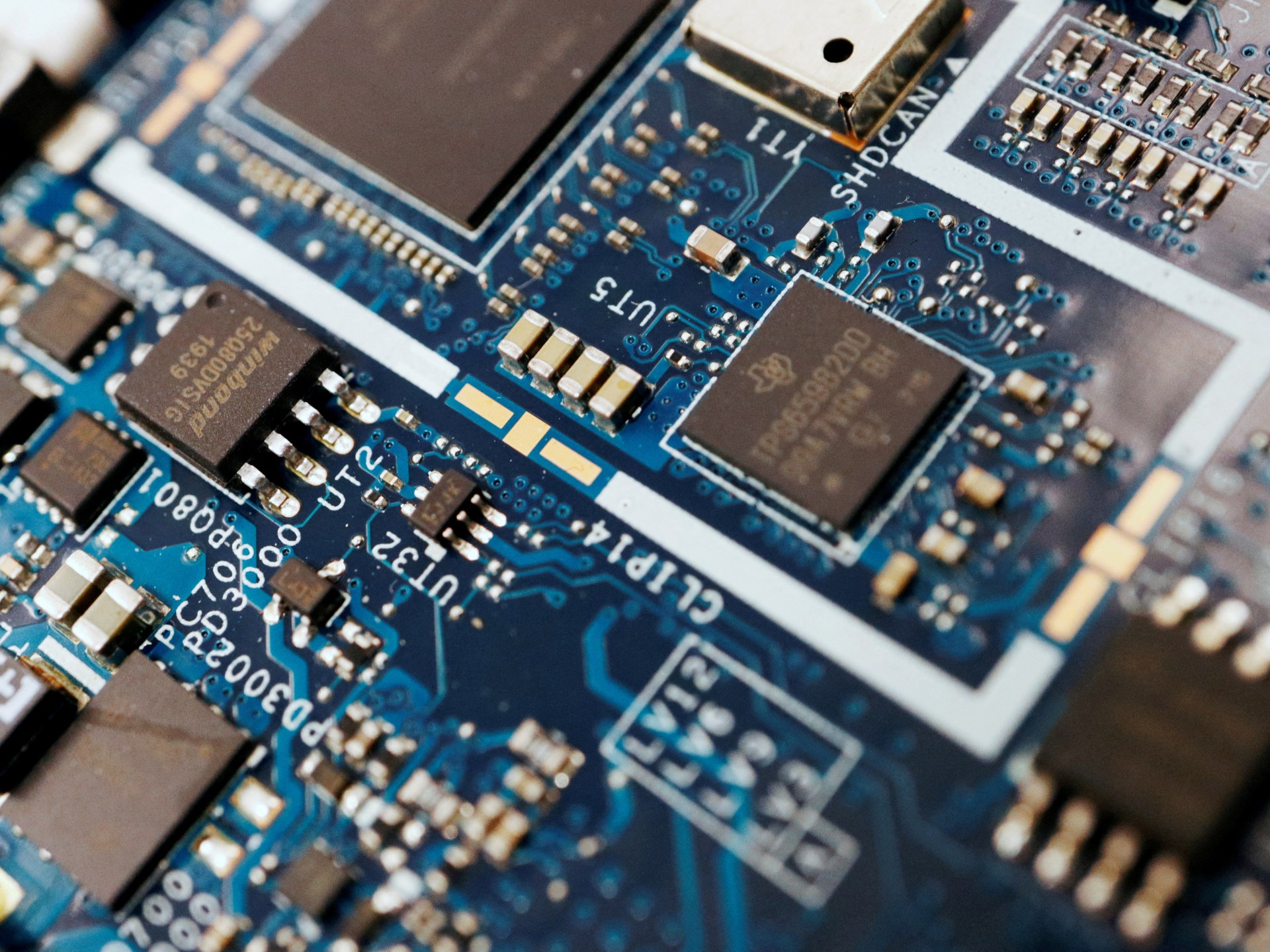

Taiwan and the United States have struck a trade deal that will see the island nation boost tech and energy investments in the US in exchange for lower tariffs.
In a statement announcing the deal late on Thursday, the US Commerce Department said Taiwan’s semiconductor and technology businesses will invest at least $250bn in the US. In exchange, it said Washington will reduce its general tariff on imports of Taiwanese goods from 20 percent to 15 percent.
- list 1 of 3China slams Netherlands for chip supply snarls tied to Nexperia
- list 2 of 3Chipmaker Nvidia hits $5 trillion valuation
- list 3 of 3Can India catch up with the US, Taiwan and China in the global chip race?
end of list
The deal illustrates an ongoing push by the US to improve access to Taiwan’s semiconductor industry. The island nation holds a dominant position in the supply of the chips used in advanced digital technology across the world and, therefore, a critical component in the global economy, but it faces Chinese claims over its sovereignty.
President Donald Trump announced a 32 percent tariff on Taiwanese goods as part of his sweeping “Liberation Day” tariffs last spring, a rate he later lowered to 20 percent.
The Commerce Department said the “historic” deal “will strengthen US economic resilience, create high-paying jobs, and bolster national security”.
In addition to investing $250bn in building and expanding advanced semiconductor, energy, and artificial intelligence production and innovation capacity in the US, Taiwan will provide at least the same amount in credit guarantees for additional investment by its businesses in the US semiconductor supply chain.
Taiwan stressed that it would remain the world’s main semiconductor supplier.
Advertisement
The island’s chip industry has long been seen as a “silicon shield” protecting it from an invasion or blockade by China – which claims the island is part of its sovereign territory – and an incentive for the US to defend it.
“Based on current planning, Taiwan will still remain the world’s most important producer of AI semiconductors, not only for Taiwanese companies, but globally,” Economic Affairs Minister Kung Ming-hsin told reporters on Friday, the AFP news agency reported.
Production capacity for the advanced chips that power artificial intelligence systems will be split about 85-15 between Taiwan and the United States by 2030 and 80-20 by 2036, he projected.
Reacting to the accord, Beijing expressed its stern opposition.
“China consistently and resolutely opposes any agreement … signed between countries with which it has diplomatic relations and the Taiwan region of China,” China’s Ministry of Foreign Affairs spokesperson said, urging Washington to abide by Beijing’s one-China principle.
Related News

Venezuela’s Machado says she hasn’t spoken to Trump since October

Greek flights restart after radio loss grinds airport operations to halt
Is the Eastern Mediterranean becoming Israel’s new front against Turkiye?