
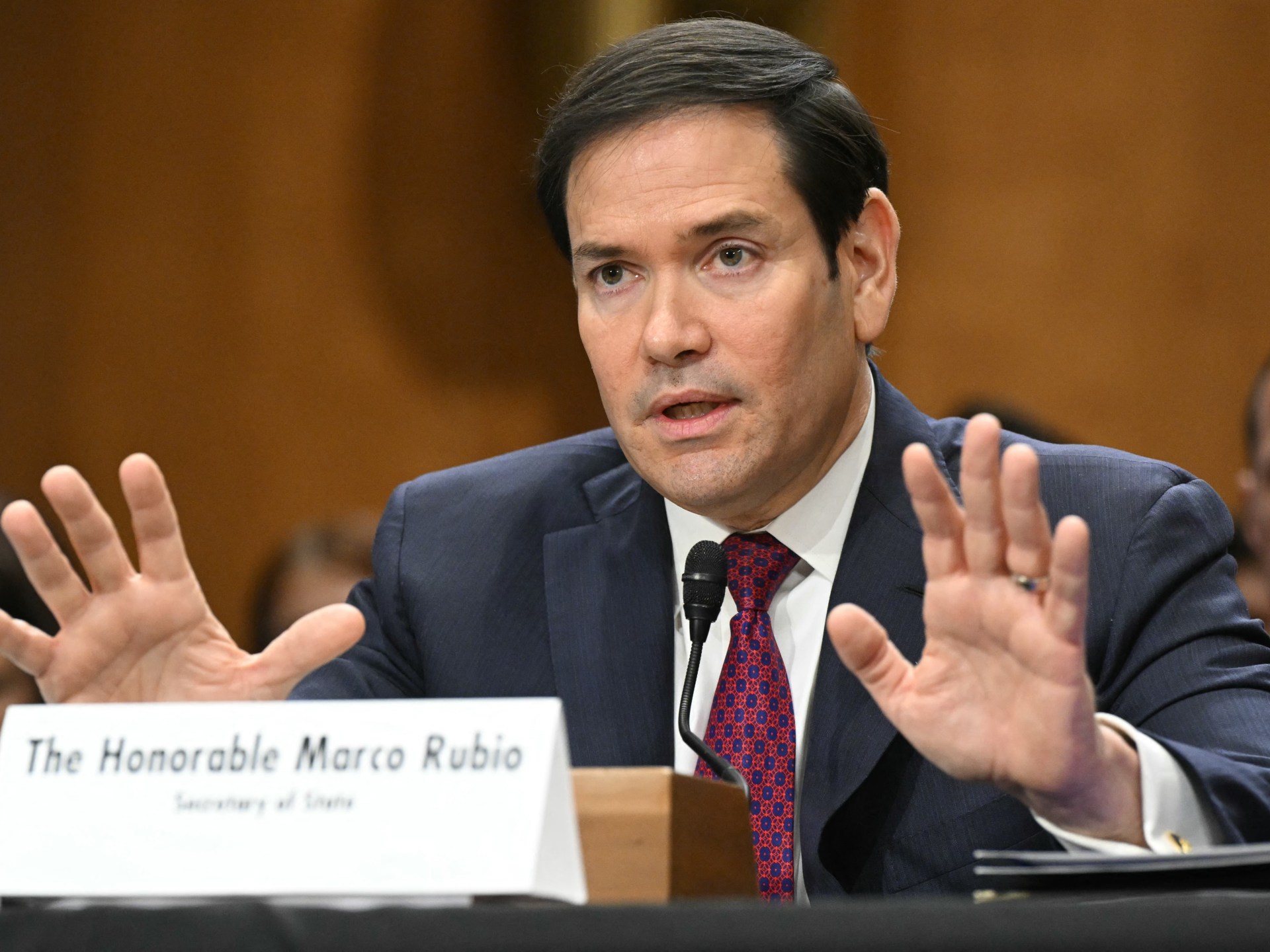

Secretary of State Marco Rubio has begun his testimony before a Senate committee hearing on the United States abduction of Venezuelan leader Nicolas Maduro.
Beginning the hearing before the Senate Foreign Relations Committee on Wednesday, Rubio defended the operation, which has been roundly condemned as a flagrant violation of international law.
- list 1 of 3‘Remote coercion’: What has US approach been since abduction of Maduro?
- list 2 of 3Cuban official accuses US of ‘piracy’ against sanctioned Caribbean island
- list 3 of 3Venezuela frees 104 political prisoners, rights group says
end of list
Rubio pointed to what he described as the “strategic” significance of the January 3 operation to abduct Maduro, describing Venezuela as a “base of operation for virtually every competitor, adversary and enemy in the world”.
He listed Venezuela’s alleged ties to Iran, Russia and Cuba.
“[Having Maduro in power] was an enormous strategic risk for the United States, not halfway around the world, not in another continent, but in in the hemisphere in which we all live, and it was having dramatic impacts on us, but also on Colombia and on the Caribbean Basin and all sorts of other places,” he told lawmakers.
“It was an untenable situation, and it had to be addressed, and now the question becomes what happens moving forward,” he said.
Rubio said the US had three objectives in Venezuela, the culmination being “a phase of transition where we are left with a friendly, stable, prosperous Venezuela – and democratic”.
In that, Rubio defended the decision of US President Donald Trump to continue working with the government surrounding Maduro, including interim President Delcy Rodriguez, while not initially supporting an opposition takeover.
Rubio said the first objective was avoiding civil war in Venezuela and aiming to “establish direct, honest, respectful, but very direct and honest conversations with the people who today control the elements of that nation”.
He said the second phase is a “period of recovery … and that is the phase in which you want to see a normalised oil industry”.
Advertisement
Speaking before Rubio, Senator Jeanne Shaheen, the top Democrat on the Senate, focused little on the wider international law implications of the Trump administration’s approach to Venezuela.
Instead, she focused on the cost, noting that the military operation and ongoing naval blockade have been estimated by some outside analysts to cost $1bn.
“So it’s no wonder that so many of my constituents are asking, why is the president spending so much time focused on Venezuela instead of the cost of living and their kitchen table economic concerns?”
Related News
Fact-checking Trump’s speech marking one year in office
‘Imperial’ agenda: What’s Trump’s Gaza development plan, unveiled in Davos?
Juliet Stevenson on Gaza: ‘I’m disappointed by the silence in my industry’