

News Americas, TORONTO, Canada, Tues. Feb. 17, 2026: For more than sixty years, Cuba has endured relentless external pressure from the United States. The embargo, designed to strangle trade, cripple the economy, and punish a population for the choices of its government, has long made daily life a struggle. Today, the situation is more difficult than ever: fuel shortages have grounded planes and paralyzed public transport; tourism, a crucial source of income, has all but collapsed; and the economy teeters under layers of scarcity and deprivation. Decades of hardship have forged resilience in the Cuban people, but the severity of these pressures makes one wonder: can Cuba survive this new trial, or are these dark hours edging it closer to the brink?
Despite these extraordinary challenges, Cuba has preserved a surprising measure of moral and social integrity. Health care remains universal, education is free and widely accessible, and violent crime is low. The government, while politically centralized and media tightly controlled, has consistently prioritized the welfare of its citizens over elite enrichment. In practical, people-centered terms, Cuba remains morally and functionally resilient, even under extreme external duress.
Contrast this with the United States, once hailed as the world’s premier democracy. Formally, Americans enjoy freedoms enshrined in law: free speech, press protections, competitive elections, and an independent judiciary.
But these formal liberties are increasingly being hollowed out in practice: There have been unprecedented calls to “nationalise” US elections and talk about cancelling the midterms – even as the blockade of Cuba is being justified as “pressuring the Cuban government to hold free elections.” At the same time, American civic trust is being battered – protests are met with militarized force as in Minnesota, while the blockade of Cuba is also unashamedly being justified in the name of “Promoting human rights and political freedoms.”
Wealth is concentrated in the hands of the top 1%, which dominates political donations, lobbying, and policy outcomes. Media ownership is similarly consolidated in the hands of a few, producing shallow, sensationalist coverage that leaves large swaths of the population misinformed. Judicial appointments are increasingly partisan.
In other words, the United States is showing the signs of a democracy under stress, much like historical empires before it: Rome, Tsarist Russia, and the Soviet Union all exhibited elite capture, norm erosion, and civic disengagement before systemic collapse. Formal freedoms exist, but meaningful self-correction has become compromised. Citizens may vote, speak, and organize, yet their ability to influence outcomes is heavily filtered through wealth, media bias, and institutional manipulation.
The contrast is striking. Here is a small island, subjected to decades of external aggression and severe deprivation, yet maintaining a society that, in practice, prioritizes the collective welfare of its people. Meanwhile, a wealthy, globally dominant democracy – free in principle – struggles to ensure that its citizens’ basic needs are met and its political system functions equitably.
Cuba’s one-party system and state-aligned media are often cited as moral deficits. Yet what moral weight do political freedoms carry if the society that claims them fails to meet the basic needs of its people? The Cuban system, despite restrictions on political plurality, has consistently delivered healthcare, education, and security – the material foundations of dignity and life.
History teaches that empires and states rarely fall suddenly; decline is usually the cumulative effect of inequality, elite capture, and norm erosion. Rome’s senatorial elites insulated themselves while ordinary citizens struggled; Tsarist Russia refused reform until the system collapsed; the Soviet Union stagnated under rigid institutions and external overreach. In each case, the formal structures of governance persisted even as the underlying moral and functional legitimacy deteriorated.
The United States now exhibits eerily similar patterns: economic inequality has hollowed out political influence; media concentration distorts public understanding; civic trust is fractured; and institutional norms are under strain. Ironically, it is the US rather than Cuba, which has survived decades of external punishment, that faces internal moral and systemic fragility – a democracy that risks eroding from within.
Kant wrote, “The worth of a person consists in being a subject capable of reason and moral choice, not merely a means to an end.” By this measure, America’s moral authority is increasingly compromised: citizens are treated less as moral subjects with agency than as data points filtered through the lens of wealth and influence.
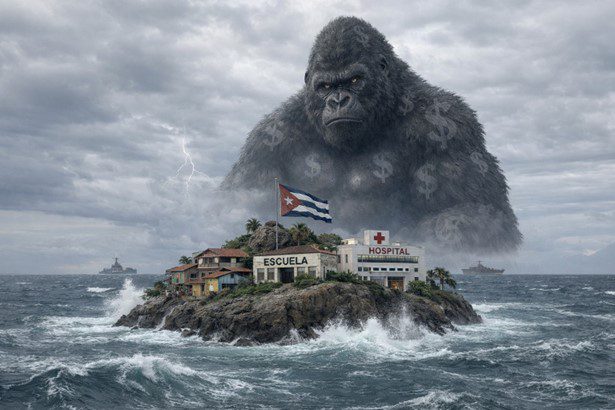
Even if we take it that Cuba’s government system is seriously flawed, the metaphor is unavoidable: the United States, a global behemoth wielding overwhelming power, functions as a predator – King Kong – crushing a small, vulnerable island beneath its weight. The embargo and aggressive sanctions on Cuba reveal a democracy that has abandoned moral principle in favor of domination. Meanwhile, Cuba, the small animal beneath the shadow of that predator, has demonstrated resilience, cohesion, and a people-centered ethic that the predator itself increasingly lacks.
Cuba has survived decades of punishment and deprivation. But the current crisis – fuel shortages, economic paralysis, and a collapse of tourism – may be the severest it has ever faced. Will the island endure these dark hours? History shows that resilience is possible, but the strain is immense, and the outcome is uncertain.
The contrast could not be starker: a wealthy, formally free democracy showing cracks in its moral and functional foundations, juxtaposed with a small, embattled island maintaining social cohesion and prioritizing human welfare under extreme external pressure. The United States has long claimed moral and political superiority; today, its claim rings hollow. It’s democracy, once celebrated, risks being remembered as a system where freedom existed in theory but was undermined by the concentration of wealth, the distortion of information, and the erosion of institutional norms.
Meanwhile, Cuba, despite political limitations, demonstrates that people-centered governance, moral integrity, and social cohesion have so far survived even under extraordinary external duress. The moral lesson is stark: power alone does not confer legitimacy; justice and care for citizens do. If the U.S. continues to prioritize domination, wealth, and spectacle over the well-being of its people, it risks becoming a giant whose size conceals rot, while a small island showed what resilience and moral governance truly look like.
EDITOR’S NOTE: Ron Cheong, born in Guyana, is a community activist and dedicated volunteer with an extensive international background in banking. Now residing in Toronto, Canada, he is a fellow of the Institute of Canadian Bankers and holds a Bachelor of Science degree from the University of Toronto. His comments are his own and do not reflect those of News Americas or its parent company, ICN.
Support NewsAmericas

Related News
Voices Of The Super Bowl: When Language Makes Us Uncomfortable
Caribbean Unity Tested As Election Interference Allegations Threaten Regional Trust

Former Turks and Caicos Premier Michael Misick Found Guilty In $20M Corruption Case