
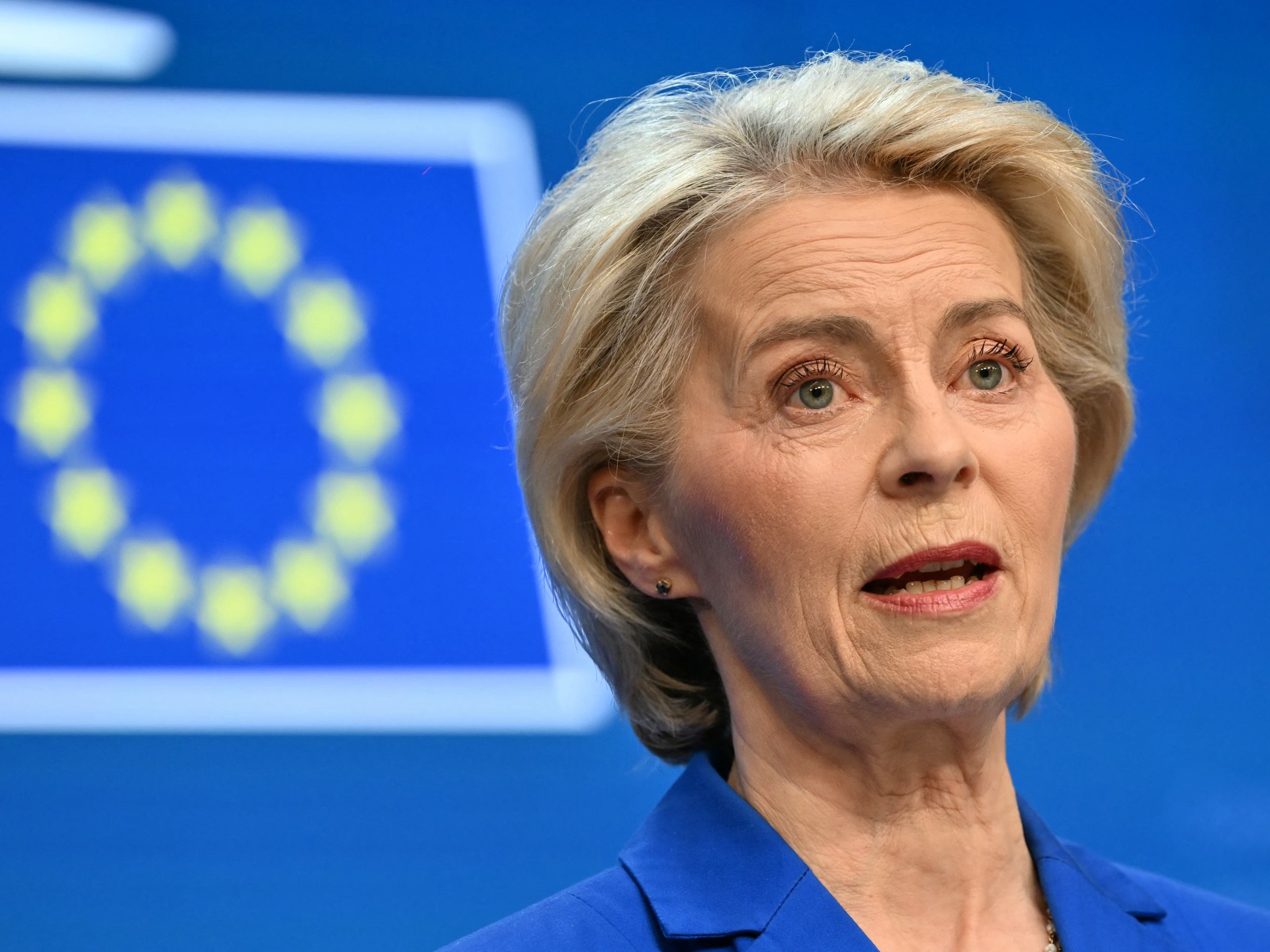

The European Commission has unveiled a new Arctic strategy for the European Union that lists security and resilience first among four priorities, alongside climate change, economic prosperity and opportunities for Arctic communities.
The strategy calls for a new maritime security hub to help member states and partners share information and monitor maritime activity in the Arctic, the Commission said on Tuesday.
- list 1 of 3Why does Greenland matter to the US?
- list 2 of 3Trump says oil, gas and mineral exploration to begin in Greenland
- list 3 of 3Denmark pushes back as Trump touts Greenland oil and mineral deals
end of list
The hub would later expand to track shadow fleet vessels, detect illegal fishing and pollution, and improve search and rescue coordination.
The Commission also said the EU will work to expand European icebreaker capacity. Icebreakers are specialised vessels designed to navigate ice-covered waters by breaking up sea ice and maintaining safe shipping routes.
“The Arctic is one place where the tectonic plates of geopolitics are colliding,” European Commission President Ursula von der Leyen said, adding that sovereignty and territorial integrity can no longer be taken for granted.
EU foreign policy chief Kaja Kallas said Russia is expanding its military footprint in the high north, citing drone incursions, GPS jamming and cable sabotage, the AFP news agency reported.
Cutting reliance on Washington
Several measures appear aimed at reducing dependence on the United States. The Commission said the EU will back a strategic pan-Arctic fibre-optic telecommunications cable project linking Greenland directly to Europe. It is part of a wider plan that would also connect Canada, Japan and South Korea.
Advertisement
The EU will also provide secure satellite connectivity for government communications through the IRIS² constellation, a constellation AFP said is meant to rival US tech mogul Elon Musk’s Starlink.
The shift follows US President Donald Trump’s repeated demands to take control of Greenland, a Danish autonomous territory. Although his tone has softened this year, with a security deal signed with Greenland and Denmark, many in Europe remain wary, AFP said.
The strategy follows last month’s meeting of leaders from 12 countries, including Germany, France, Finland and Denmark. Member states urged the EU to take a more strategic and proactive role, according to a joint statement.
Participants identified Russia as the largest threat while noting the ambitions of China and the US.
At the meeting, German Chancellor Friedrich Merz said the era of “high north, low attention” was over. Finnish Prime Minister Petteri Orpo called Russia the most significant long-term threat and said the EU must treat the Arctic as a strategic frontier.
The Commission reiterated the EU’s position remains that oil, coal and gas should stay in the ground, including in the Arctic.
To combat increasing climate concerns, the Commission pledged to “strengthen climate research, observation and monitoring to better understand these changes and support effective responses”, while working in tandem with the people who live and work in the Arctic.
Related News
Trump signs order launching women’s health division at NIH, White House
Oman evacuates injured crew from attacked tanker in Strait of Hormuz
Trump administration to defend its ban of major news outlets in court