

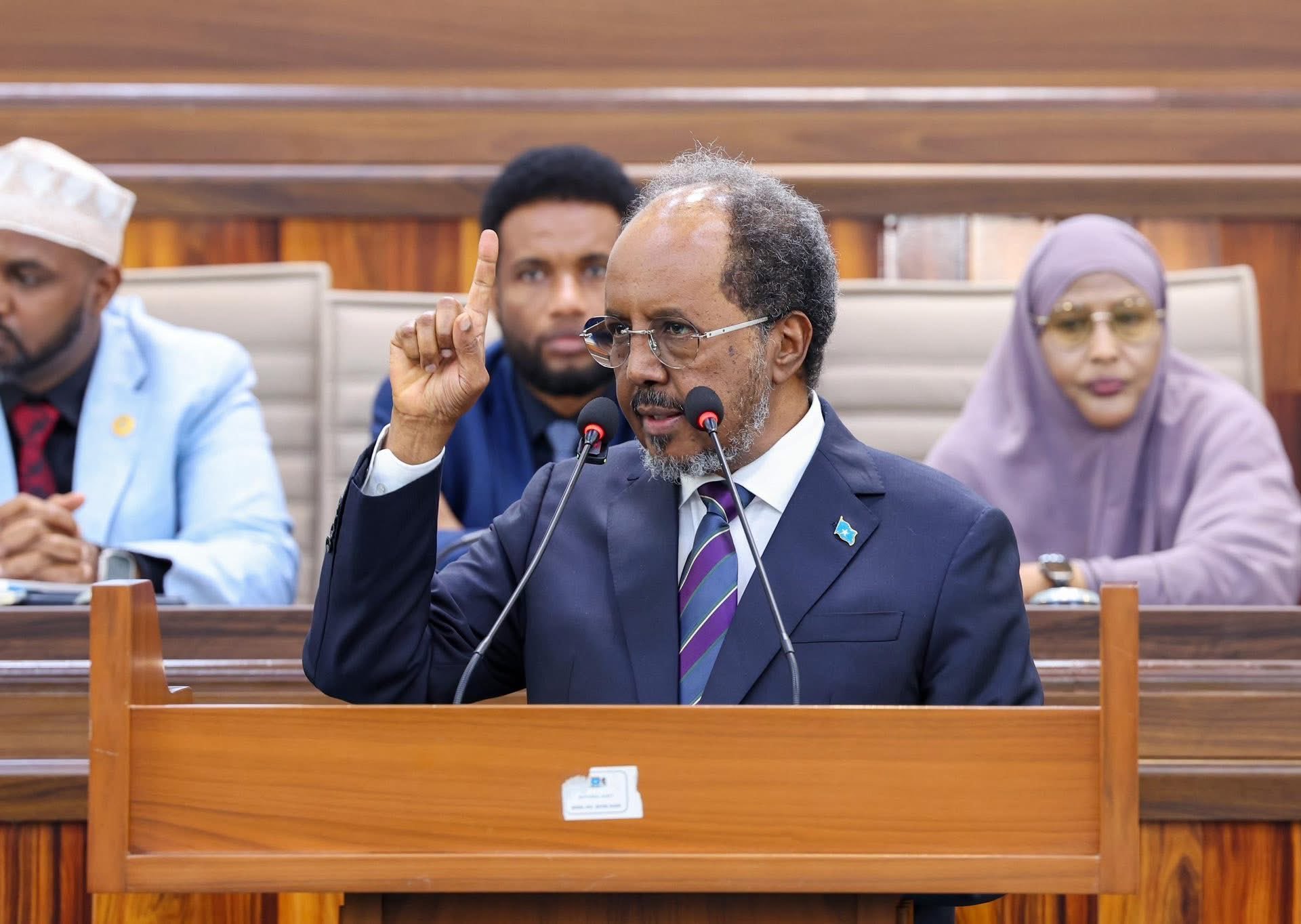

Mogadishu, Somalia – A day before Somalia’s Supreme Court was due to rule on whether President Hassan Sheikh Mohamud had lawfully extended his term by a year, he abruptly dismissed the chief justice presiding over the case.
On November 4, the presidency removed Chief Justice Bashe Yusuf Ahmed, citing complaints about the administration of justice. Five judges proceeded with the case the following day, ruling that constitutional amendments extending presidential and parliamentary terms from four to five years could not apply retrospectively to those already in office. Their mandates, the judges said, had expired.
- list 1 of 3‘Boxed through my skin’: British-Somali boxer Ramla Ali wins first title
- list 2 of 3Security forces seized top court, Somalia’s ex-chief justice says
- list 3 of 3Somalia’s decades-long journey to stability
end of list
The government rejected the ruling and immediately swore in a replacement chief justice, setting up a direct confrontation between the president and the country’s highest court over the end of his mandate and the timing of elections.
The standoff marks the latest escalation in a two-year political contest over Mohamud’s proposed constitutional changes.
Intended to address long-standing structural problems that have hindered Somalia’s reconstruction, the changes have instead deepened divisions over the country’s political future, the nature of its federal system and the distribution of power.
Mohamud and his allies believe stronger national institutions, clearer rules and direct elections will help advance Somalia’s decades-long state-building project.
The deadlock has increasingly spilled beyond parliament and political negotiations, with tensions playing out on the ground.
Advertisement
Two federal states have suspended cooperation with Mogadishu, while disputes elsewhere have turned violent. In June, clashes between government forces and militias guarding a former president and prime minister brought part of the capital to a standstill for two days.
A federal bargain left unfinished
Somalia’s effort to rebuild a functioning national government is one of the world’s longest-running state-building efforts, hampered by a decades-long civil war.
After the central government collapsed in 1991, regional administrations emerged around clan alliances, building their own institutions, security forces and revenue streams.
Somaliland was the first to emerge from the ashes of Somalia’s civil war, declaring independence in 1991. Puntland followed in 1998, establishing an autonomous administration. Other regional administrations emerged in subsequent years, eventually forming part of the country’s evolving federal system.
The provisional constitution adopted in 2012 established a federal framework for sharing power between Mogadishu and the regions. However, some of the most contentious questions over the division of powers and control of resources were deferred as national institutions took shape.
Those unresolved questions made governance dependent on constant negotiation. Elections depended on agreements among regional leaders and clan elders, while disputes over power and revenue repeatedly delayed national decisions in the absence of consensus.
“Control of ports and trade routes, and relationships with foreign governments, gave some considerable independence from Mogadishu,” Jethro Norman, a Somalia expert at the Danish Institute for International Studies, told Al Jazeera.
Norman said Mohamud’s overhaul seeks to give Mogadishu greater legal authority over areas that regional administrations have long controlled, although enforcing that authority is another matter.

“What you’re seeing is the federal system crystallising into two camps,” he told Al Jazeera. “You have Villa Somalia presenting the constitution as completing the state: one person, one vote, multi-party politics, democracy, central federal control over foreign relations and national security, and so on.”
Puntland and Jubaland, by contrast, see the changes as an imposition that undermines the original federal bargain.
“Their view is that the 2012 constitution was a bargain between the centre and the regions, and it can’t just be re-written through a parliamentary majority in Mogadishu when the regions have rejected it,” Norman said.
Advertisement
Some federal states retain close commercial and security ties with the United Arab Emirates (UAE), which Mohamud, who has frosty ties with Abu Dhabi, has accused of supporting regional leaders in their disputes with Mogadishu.
In January, Mohamud’s government announced the cancellation of the UAE’s port and security agreements across Somalia. The regional states, however, rejected the decision.
The dispute has added to tensions over the future of the federation. Puntland President Said Abdullahi Deni, whose administration is among Somalia’s most autonomous, has even suggested that the country may need to reconsider how it holds together.
“If a solution is not found for the current debate, Somalis must deliberate and decide on another alternative way to live together,” he warned.
The stakes have also grown with international recognition of Somaliland. Israel became the first United Nations member state to recognise the breakaway northern region at the end of 2025.
Somali academic Afyare Elmi told Al Jazeera that the government was weakening the fragile consensus underpinning the 2012 settlement by pushing through constitutional changes it could not enforce in states that opposed them.
“This is one of the most dangerous times the Somali political system has faced,” he said. “Somalis are no longer moving in the same direction on the future of the state.”
Completing the constitution
Mohamud himself helped shape the federal system he is now seeking to overhaul.
During his first presidency, from 2012 to 2017, his government participated in negotiations to establish or consolidate several federal member states. After returning to office in 2022, he oversaw the creation of another state and made completing the constitution and introducing direct elections key priorities.
Yet the boundaries of some federal states remain disputed, reflecting what Elmi, the Somali academic, described as the haphazard way in which the federal system was assembled.
Parliament passed the first constitutional amendments in 2024 and approved the remaining changes in March 2026, bringing a 14-year review process to a close. The overhaul seeks to resolve questions about the division of powers that Somalia’s leaders left unsettled in 2012.
The changes give Mogadishu greater authority over revenue collection and sharing, elections and the conditions under which the federal government can intervene in member states.
They also provide for citizens to elect members of the federal lower house directly through a national electoral commission, although parliament will continue to choose the president.
Though Mohamud helped establish several federal member states during his first presidency, Elmi questioned whether he had ever intended for them to exercise significant autonomy from Mogadishu.
“Hassan Sheikh always wanted a Mogadishu-centred federal state, with no real federal substance,” he said.
Ali Mohamed Omar, Somalia’s state minister for foreign affairs, told Al Jazeera that the previous system, under which clan elders and delegates selected members of parliament, had left successive governments without the public legitimacy they needed.
Retaining parliament’s power to elect the president, rather than introducing a direct presidential vote, was a compromise intended to secure the support of some opposition groups, Omar said.
Advertisement
Mohamed Ibrahim Moalimuu, a federal lawmaker who supports the overhaul, described the president’s decision to press ahead as “daring”. Successive governments had tried and failed to complete the constitution, he said, while most Somalis had yet to gain the right to elect their national representatives directly.
“Somalia cannot just remain stuck just because the changes made aren’t considered perfect for everyone,” he told Al Jazeera.
For regional presidents and clan elders, however, the changes threaten to diminish their influence over the selection of members of parliament and weaken the political leverage they have built up in negotiations with Mogadishu.
Puntland rejected the first amendments in 2024 and withdrew its cooperation with the federal government. Jubaland followed after a dispute over electoral legislation.
Both have their own security forces and revenue sources, and their leaders argue that agreements reached without their participation cannot be imposed on them.
Elections and political power
The consequences have been most pronounced in South West state, where a dispute over President Abdiaziz Hassan Laftagareen’s re-election in March has escalated into a struggle for control of Baidoa, the regional capital.
Mogadishu rejected the vote and federal troops ousted him. Since then, forces loyal to Laftagareen have seized several strategic towns around the city and clashed with government troops.
Following Laftagareen’s removal, South West held Somalia’s first direct election for a federal state assembly in May, a milestone for Mohamud’s reforms. The newly elected lawmakers chose Mohamud ally Sheikh Adan Mohamed Nur Madobe as regional president the following month.
Laftagareen, now in exile in Nairobi alongside senior members of his former administration, told Al Jazeera he intended to return to Baidoa and remove Madobe’s government from power.
He said he had repeatedly warned Mohamud against changing the constitution without first building broader consensus among the country’s political elite.
“Separating powers between the centre and the regional governments saved and kept Somalia together, and making these changes is driving the country apart,” he said.
Not all federal states oppose Mohamud’s reforms. His allies now lead four of Somalia’s six states, where recent elections have also strengthened his Justice and Solidarity Party.
But the outcome in Hirshabelle, one of those states, has prompted further resistance in its Hiiraan region, where political leaders and elders say long-standing grievances over political representation have yet to be addressed. Armed fighters have occupied parts of the regional administration’s offices in Beledweyne.
Moalimuu acknowledged that the recent elections “weren’t totally free and fair”, but argued that giving citizens the opportunity to vote was an important first step.
The electoral commission has scheduled parliamentary elections for April 15, 2027, followed by parliament’s election of the president on May 15. The timetable is based on the new five-year terms, even though the Supreme Court ruled that the extension could not apply to officials already in office.
Mohamed Mahmoud Dirie, a spokesperson for the Somali Future Council, a coalition of politicians including former presidents and prime ministers, said the group had rejected Mohamud’s invitation to talks in November.
“Our request for a guarantor from the international community for whatever is agreed was rejected, which will make it difficult to ensure that the government holds to its side of the bargain,” Dirie said.
Advertisement
The political divisions are deepening as international support for Somalia’s reconstruction comes under growing pressure. The UN political mission, which supported Somalia’s constitutional negotiations, elections and reconciliation efforts, closed in October at the government’s request.
The African Union Support and Stabilization Mission in Somalia (AUSSOM), which is supporting Somali forces in their fight against al-Shabab, also faces funding shortages and uncertainty over continued UN logistical support for its operations.
Uganda has begun withdrawing its bilateral troops and plans to withdraw its AUSSOM contingent by the end of 2027, while humanitarian aid is also shrinking.
“Somalia is going through multiple difficult transitions,” Mahad Wasuge, executive director of the Mogadishu-based think tank Somali Public Agenda, told Al Jazeera.
Wasuge said these changes could leave Somalia increasingly exposed at a time when “the trust between elites is low”.
Related News
Kenya’s 2029 World Athletics bid: A win for Africa under scrutiny
Are Houthis using Russian satellites as Saudi Arabia faces hits?
The anti-Netanyahu: Can Gadi Eisenkot give the world a different Israel?