
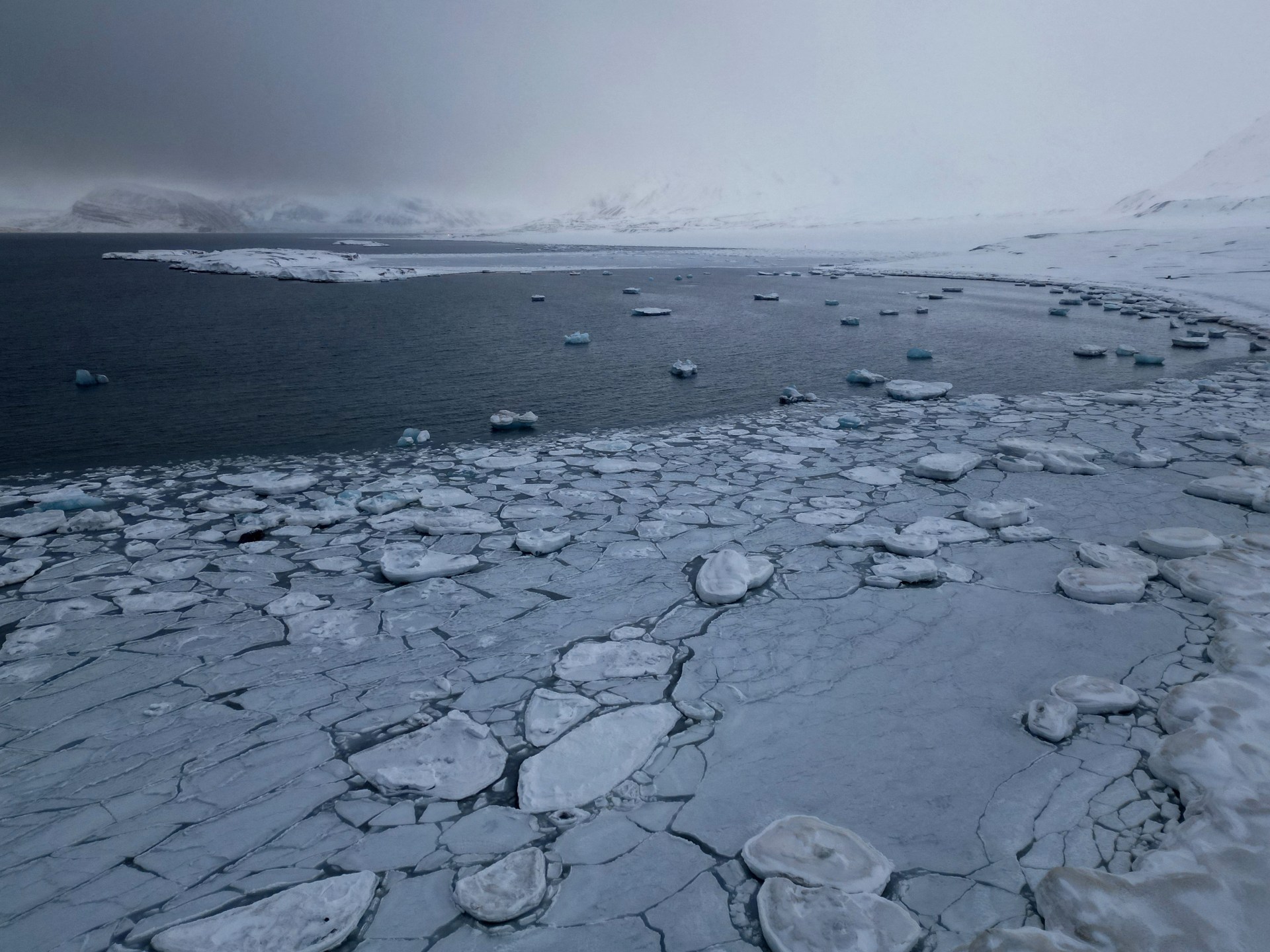

A new report has found unprecedented temperature rises and significant loss of snow and ice in the Arctic, a region now described as “warming far faster than the rest of the planet”.
The annual Arctic Report Card published by the US National Oceanic and Atmospheric Administration (NOAA) on Tuesday found that surface air temperatures across the Arctic between October 2024 and September 2025 were “the warmest recorded since 1900”.
- list 1 of 4Trump torpedoes international deal to reduce shipping emissions
- list 2 of 4True climate justice demands a reckoning with colonialism
- list 3 of 4At least 1,250 people dead: What caused the devastating Asia floods?
- list 4 of 4‘We don’t want to disappear’: Tuvalu fights for climate action and survival
end of list
Last year’s unusually high temperatures capped off a decade of record highs in the region surrounding the North Pole, according to the report, which was a collaboration of 112 authors from 13 different countries.
In the 47 years that satellite images have been used for recording and measurement, winter sea ice reached its lowest levels in March 2025, while snow cover over the Arctic in June was half what it was six decades ago, the report found.
The report card was the 20th to be released annually by NOAA, a US government agency that appears to have undergone changes to its scope of work under the Trump administration.
The report’s authors presented their findings at a news conference where a reporter asked about statements made by NOAA officials under previous US administrations, linking environmental changes in the Arctic to fossil fuel pollution.
Steven Thur, NOAA’s acting chief scientist, responded to the question without referring to fossil fuels or climate change directly.
“We recognise that the planet is changing dramatically. Our role within NOAA is to try to predict what’s going to occur in the future by documenting what’s occurring today,” Thur said.
Advertisement
According to the Sabin Center for Climate Change Law at Columbia University, multiple federal agencies have scrubbed references to climate change from their websites under the second Trump administration.
This has included “the entire page on climate change on the White House website” and “content that provided assessments on an area’s vulnerability to wildfire” on the US Department of Agriculture’s website.
Federal researchers have also “seen their studies disappear from agency websites”, the Sabin school said.
Despite the cascading environmental harms caused by climate change, several countries, including the US, Russia and Norway, are reportedly planning to expand mining operations in the Arctic region.
In October, Kremlin investment envoy Kirill Dmitriev said on X that a 112km (70-mile) “railroad and cargo link” between Siberia and Alaska would “unlock joint resource exploration” between the two countries.
“Certainly, Russia is eyeing the opportunity of joint Russia-China-US projects, including in the Arctic region, specifically in the energy sector,” Dmitriev said in remarks reported by Russia’s TASS state news agency a month earlier.
The Trump administration has also announced new offshore oil drilling plans that include 21 new five-year offshore oil and gas leases from the Gulf of Alaska to the High Arctic, according to the Alaska Beacon newspaper, fulfilling Trump’s election promise to “drill, baby drill”.
The plans from the US and Russia contrast with the results of a 2024 United Nations Development Programme (UNDP) and Oxford University poll, which suggested that 80 percent of people surveyed worldwide want to do more to address climate change.
Countries and companies that are pushing ahead with more fossil fuel projects despite the risks are also facing increasing legal challenges, including from a recent ruling from the International Court of Justice (ICJ), which found polluters have a responsibility to clean up their acts.
Related News
Palestinian infant freezes to death in Gaza as Israel keeps blocking aid

US Congress advances bill to nix Caesar Act sanctions on Syria

US dramatically escalates air strikes on Somalia under Trump this year