Catalonia’s new far right: How anti-Muslim sentiment is reshaping politics
 21 October 2026
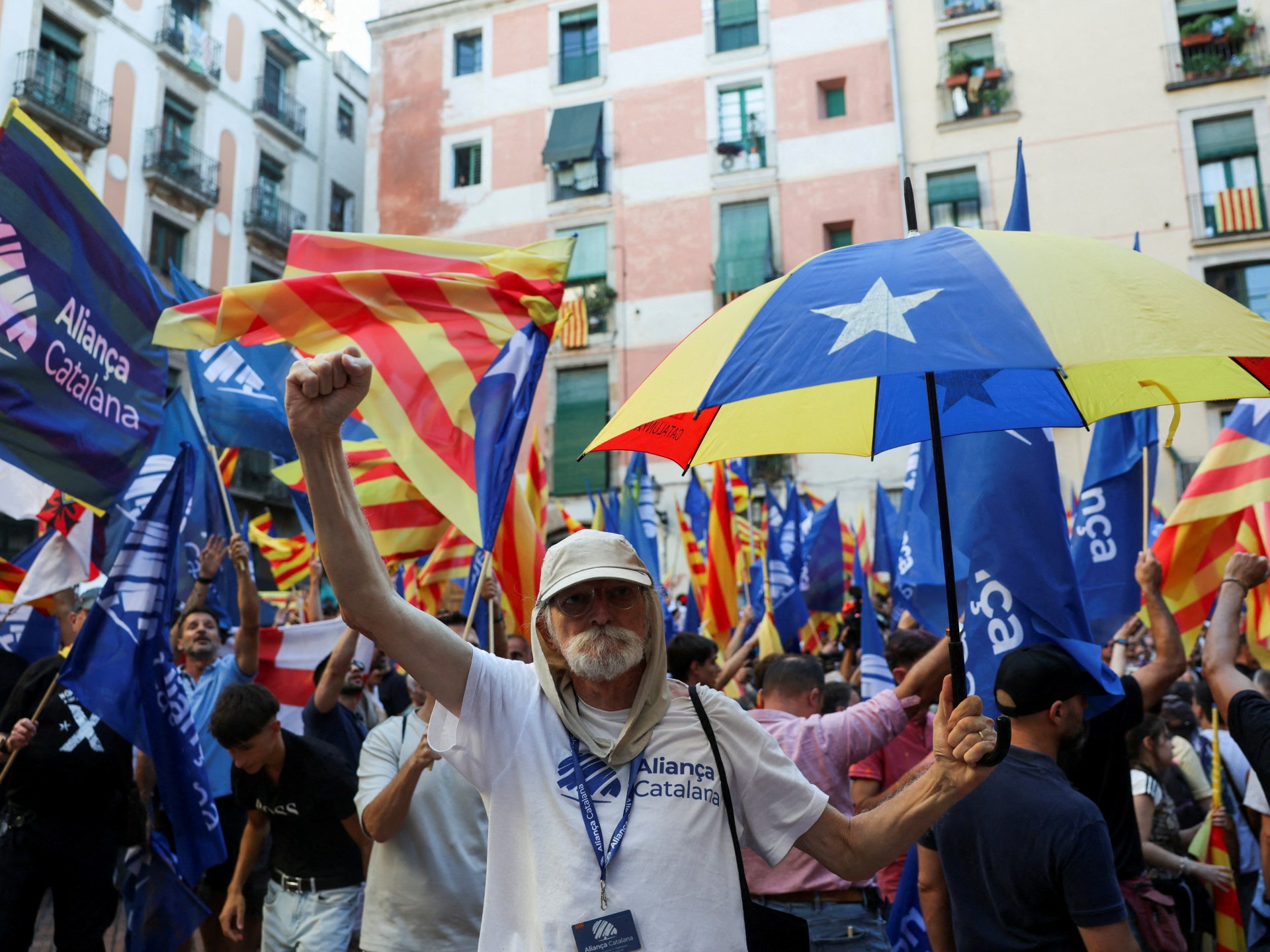

Barcelona, Spain – Almost a decade after a failed independence bid in Catalonia, anti-migration and anti-Muslim sentiment has replaced secession as the driving force among voters in this wealthy region.
A new far-right party, Alianca Catalana, or Catalan Alliance (AC), which wants a crackdown on migration and has targeted Islam as a threat to society, has surged in the polls in a region with the largest Muslim population in Spain.
- list 1 of 4Vox rises as Sanchez battles political turmoil: Could Spain swing right?
- list 2 of 4Catalan separatist Puigdemont to return to Spain after warrant lifted
- list 3 of 4Barcelona scraps Spain World Cup tribute amid fans’ Catalan flag support
- list 4 of 4Spain’s Sanchez announces snap election amid pressure over housing crisis
end of list
The party is on course to become the second biggest political force in Catalonia after the Socialists at the next Catalan regional election in 2028, polls predict.
It has capitalised on the anti-migrant sentiment sweeping Europe, which has seen victories for the far-right in Germany, Italy, and France.
The rise of Catalan Alliance has alarmed Muslims, who fear a backlash in a country which has previously seemed welcoming.
“This has surprised all of us,” said Soukayna El Abdi, president of the Young Moroccans of Ripoll, referring to the party’s growth.
“Most people come to integrate, to work and live among others. The rise of [Catalan] Alliance is about unfounded hate. They spread lots of things about our community which are not true.”
Spain will vote in a snap election in November. Polls show the conservative People’s Party and the far-right Vox gaining support. The rise of the Catalan Alliance shows a shift towards the right in the fourth biggest economy in the eurozone.
The party backs independence and has taken support from the other secessionist parties, Together for Catalonia and Catalan Republican Left, which were behind the failed bid to break away from Spain in 2017.
Advertisement
“All my friends support Catalan Alliance. There are too many migrants around now and Islam is a threat,” Eduard Lopez, a businessman from Molins de Rei near Barcelona, told Al Jazeera. “These other independence parties are from the past. They failed to do what they said they would.”
A fifth of Spain’s population of nearly 50 million was born outside the country, according to the Spanish National Statistics Institute (INE). Colombians, Venezuelans and Moroccans are the three largest groups by nationality.
Catalan Alliance started in Ripoll, a small town near the French border. It was where members of a cell plotted an attack on Barcelona in 2017 which killed 16 people and was claimed by ISIL.
Silvia Orriols, leader of Catalan Alliance, is also mayor of the town.
After the 2017 attack, she became fervently anti-Muslim.
“If there is no substantial change, the prospects for Catalonia are bleak,” Orriols told Al Jazeera.
“The decline in the use of our own language, the depersonalisation of neighbourhoods, the rise in insecurity and crime, the fraudulent use of public services, the mass and invasive immigration, the demographic growth of those who advocate [Islamic] law, the fiscal plundering we suffer by Spain, threaten the welfare state and the rights and freedoms we have achieved up to now.”
She said her party was for “those who have not surrendered to globalisation and barbarism”.
There are 2.4 million Muslims living in Spain, with the largest community in Catalonia, according to the Union of Islamic Federations of Spain.
El Abdi of the Young Moroccans of Ripoll said, “I am very scared. I fear for my parents and my two brothers who still live there. This racism affects all Muslims. It started after the 2017 attack in Barcelona.”
Ironically, she said, Orriols’ daughters used to be friends with her cousins, but this changed after the Catalan Alliance leader went into politics.

The party currently has just two seats in the Catalan parliament, but polls predict it is set to rival the Socialists to run a region which accounts for 20 percent of the Spanish economy.
A poll for El Mundo newspaper, published in September, found the Catalan Alliance would win 25-28 seats, with 16.7 percent of votes if there were an election. The Socialists would be the largest party but would lose 10 seats, garnering 23.3 percent of support and 19-22 seats. All other secessionist parties would lose out.
Advertisement
Juan Ignacio Castien Maestro, a specialist in Islamic affairs at the Complutense University in Madrid, said anti-Muslim feeling is on the rise in Spain.
“People are focusing on Islamophobia, which has existed for centuries but has risen in Spain in recent years. The Muslim migrant is seen as the symbol of many ills such as the housing crisis, unemployment and other problems. It plays on feelings of insecurity,” he told Al Jazeera.
“Catalonia is a special case in that some Catalan [nationalist] parties were already Islamophobic.”
Jose Pablo Martínez, a specialist in migration at the Real Elcano Institute, a think tank in Madrid, said the left-wing Spanish government, unlike many other European countries, is applying a policy which is more favourable towards migration.
But “certain sections of the population consider migrants to be competing for their jobs and housing,” he said.
Related News

Judge orders Meta to pay $25bn in fines for Facebook privacy violations

Israel could’ve ended Gaza war, freed captives sooner: Israel ex-negotiator
Search under way for four soldiers missing after gang attack in Haiti