

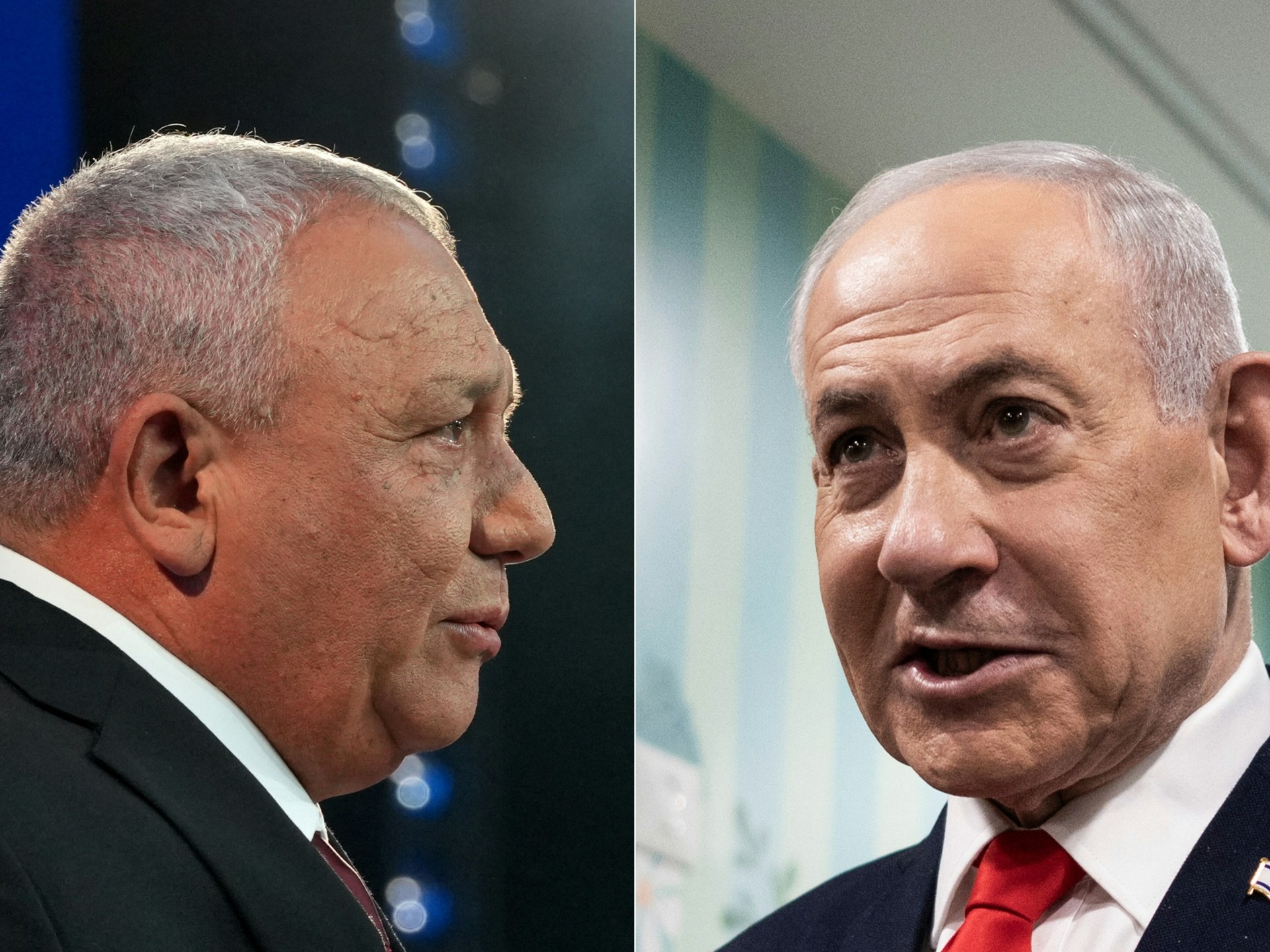

The two Israeli leaders hold a ‘businesslike’ meeting after PM Netanyahu offers to temporarily relinquish power in a unity government.
Israeli opposition leader Gadi Eisenkot has appeared to dismiss the possibility of forming a unity government with caretaker Prime Minister Benjamin Netanyahu, amid suggestions he may attempt to form a minority government.
They met for two hours on Sunday in Tel Aviv, the second such meeting this month – although the first had been described as a security briefing for the Yashar party leader.
Recommended Stories
list of 4 items
- list 1 of 4Israel’s Eisenkot accuses Netanyahu’s party of stalling coalition talks
- list 2 of 4Israel unity government talks stall: What happens now?
- list 3 of 4Israel’s Netanyahu, Eisenkot meet after rotating premiership proposal
- list 4 of 4Eisenkot, Netanyahu hold talks: Can they agree on a unity government?
end of list
In a joint statement, Netanyahu and Eisenkot said, “The discussion was businesslike, with both sides seeking to bridge the substantial differences between them.”
A spokesperson for Eisenkot confirmed reports that there were no further meetings planned between the two, with reports that he had told Netanyahu that he was “committed” to his coalition partners.
Israel’s Channel 12 news cited Eisenkot as telling Netanyahu: “I’m committed to my partners in the [opposition] bloc. You’re welcome to join after the government is formed.”
The moves come after Netanyahu said on Saturday that he would be willing to temporarily relinquish power in a unity government led by Eisenkot, offering to go second in a rotation agreement.
He said Likud, as the largest party in parliament, should ordinarily lead a unity government, but that he was willing to set aside that principle because of the security threats facing Israel.
Eisenkot welcomed the possibility of negotiations but questioned Netanyahu’s willingness to compromise. The former army chief has accused Netanyahu of deliberately prolonging negotiations to trigger another election, which would allow him to remain caretaker prime minister.
Advertisement
‘Existential threat’
Eisenkot has until December 6 to secure a parliamentary majority, but disagreements over the inclusion of parties led by Palestinian citizens of Israel and ultra-Orthodox Jews have complicated efforts to form a coalition government.
Both Netanyahu’s and Eisenkot’s blocs have refused support from Palestinian-Israeli parties, which won a record 19 seats in the 120-member Knesset.
Yousef Jabareen, head of the Joint List – an alliance of parties representing Palestinian citizens of Israel – said that he was ready to join a coalition led by Eisenkot, adding that there should be no talks with Netanyahu regarding a unity government.
“Every additional day, every additional hour and every additional minute that Netanyahu remains in power constitutes an existential threat to our community and to the public at large,” he said on X.
Winning the support of ultra-Orthodox Jewish parties could prove more difficult, due to disagreements about whether ultra-Orthodox men should serve in the military.
The Knesset defeated a bill to freeze arrests of ultra-Orthodox draft dodgers. Eisenkot’s bloc opposed the bill, while Netanyahu and his partners voted in favour.
Related News

US midterms 2026: What key races remain undecided?

British adventurer Karl Bushby returns home after 28-year walk around world
Iran flogs singer Parastoo Ahmadi for performing without headscarf