
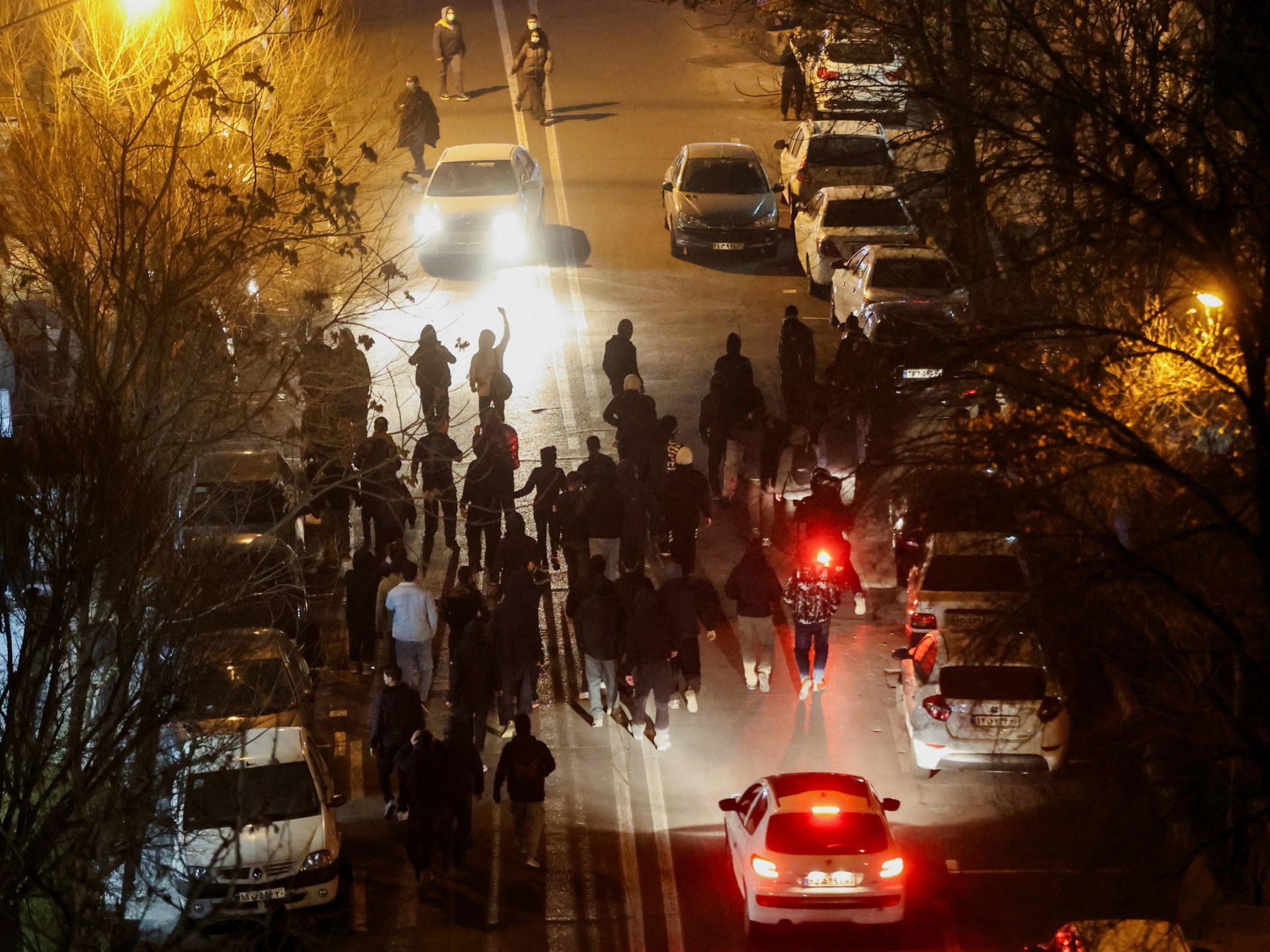

Iranian authorities have been increasingly clear that they believe foreign countries are behind the unrest sweeping the country – and are involved in fomenting unrest on the ground.
On Monday, President Masoud Pezeshkian shifted focus away from Iran’s stuttering economy and suppression of dissent and towards his country’s longstanding geopolitical adversaries, Israel and the United States.
- list 1 of 4How US sanctions crippled lives of Iranians Trump says he wants to ‘help’
- list 2 of 4How will Trump’s new 25% tariff impact Iran’s trading partners?
- list 3 of 4Why Iran is not repeating 1979
- list 4 of 4Trump cancels US-Iran meetings, urges protesters to take over institutions
end of list
Speaking on state broadcaster IRIB, Pezeshkian claimed that “the same people that struck this country” during Israel’s 12-day war last June were now “trying to escalate these unrests with regard to the economic discussion”.
“They have trained some people inside and outside the country; they have brought in some terrorists from outside,” he said, alleging that those responsible had attacked a bazaar in the northern city of Rasht and set “mosques on fire”.
The prospect of direct foreign intervention in support of Iran’s protesters appears to be growing daily, with US President Donald Trump repeatedly signalling a readiness to attack.
In Israel, far-right Heritage Minister Amichai Eliyahu told Army Radio last week, “When we attacked in Iran during ‘Rising Lion’ [Israel’s June attack on Iran], we were on its soil and knew how to lay the groundwork for a strike. I can assure you that we have some of our people operating there right now,” stopping short of claiming that Israeli agents were seeking regime change.
Writing on social media earlier this month, former US Secretary of State Mike Pompeo, who is also a former director of the CIA, did acknowledge the presence of Israeli agents operating on the ground in Iran, wishing “Happy New Year to every Iranian in the streets. Also to every Mossad agent walking beside them.”
Advertisement
Despite its wars with Syria, Yemen, Lebanon and the genocide it has unleashed on Gaza, it is Iran that looms largest in the minds of many Israelis as the most deadly of the many enemies they face.
Israeli Prime Minister Benjamin Netanyahu has repeatedly claimed that Tehran stands on the brink of developing nuclear weapons and is responsible for backing Israel’s opponents across the region.
“I don’t know if it’s Netanyahu pushing it or the whole of society,” Israeli political scientist Ori Goldberg said. “Israelis are desperate for any sign of a … masterplan in which they … will unite against any foe threatening their destruction.”
Israel has a history of covert operations in Iran.
Previous Israeli operations have targeted Iran’s nuclear and missile programmes and embedded agents and weapons systems inside Iranian territory.
Israeli intelligence has also exploited its presence within Iran to conduct a series of high-profile assassinations of nuclear scientists and politicians, including the Palestinian group Hamas’s political leader Ismail Haniyeh, who was killed while attending Pezeshkian’s inauguration ceremony in July 2024.

Israel is also widely acknowledged to have infiltrated deep into Iran and its security networks in the weeks before the June war. At that time, Israel was not only able to target scientists and officials involved in the country’s nuclear programme for assassination, but also to assemble and launch drones from within Iranian territory.
“My assumption is that the Mossad is active in Tehran behind the scenes,” said Ahron Bregman, who teaches at King’s College London and has written extensively on Israeli intelligence operations. “Israeli officials are unusually quiet. [There are] clear instructions not to talk [and] not to be seen to be involved in any way.”
“I assume there are Israeli agents on the ground, reporting back on the situation from the streets, particularly now that the internet in Iran is down,” he continued. “Operationally, it is easier to do things on the ground as it is so chaotic now.”
In the eyes of many analysts, Iran’s internal cohesion has been fundamentally undermined by the long-running series of protests and unrest, which has allowed for the infiltration of foreign security services.
Exacerbating those fissures has been the toxic mixture of crippling sanctions, corruption and the deaths of protesters.
Advertisement
“I’d be very surprised if Israeli agents were not active within Iran right now,” defence analyst Hamze Attar said. “They’re going to be doing everything they can to make sure these protests continue and escalate.”
“Principally, they’re going to try to provide the demonstrators with what they need most: exposure,” Attar continued. “People have come to expect violence from the Iranian regime. What [the protesters] need is to know it’s not for nothing. That’s what Israel and the US will be focusing on: providing the internet access that will allow people to share footage of what’s happening to them. The protesters will know where [what countries that support] is coming from, but right now – in the midst of the chaos – they’re very unlikely to care.”
Related News
Jailed Palestine Action activist ends 60-day hunger strike as health fails
Thousands of Irish farmers protest EU’s Mercosur trade deal

Trump to meet with Venezuelan opposition leader Machado on Thursday