

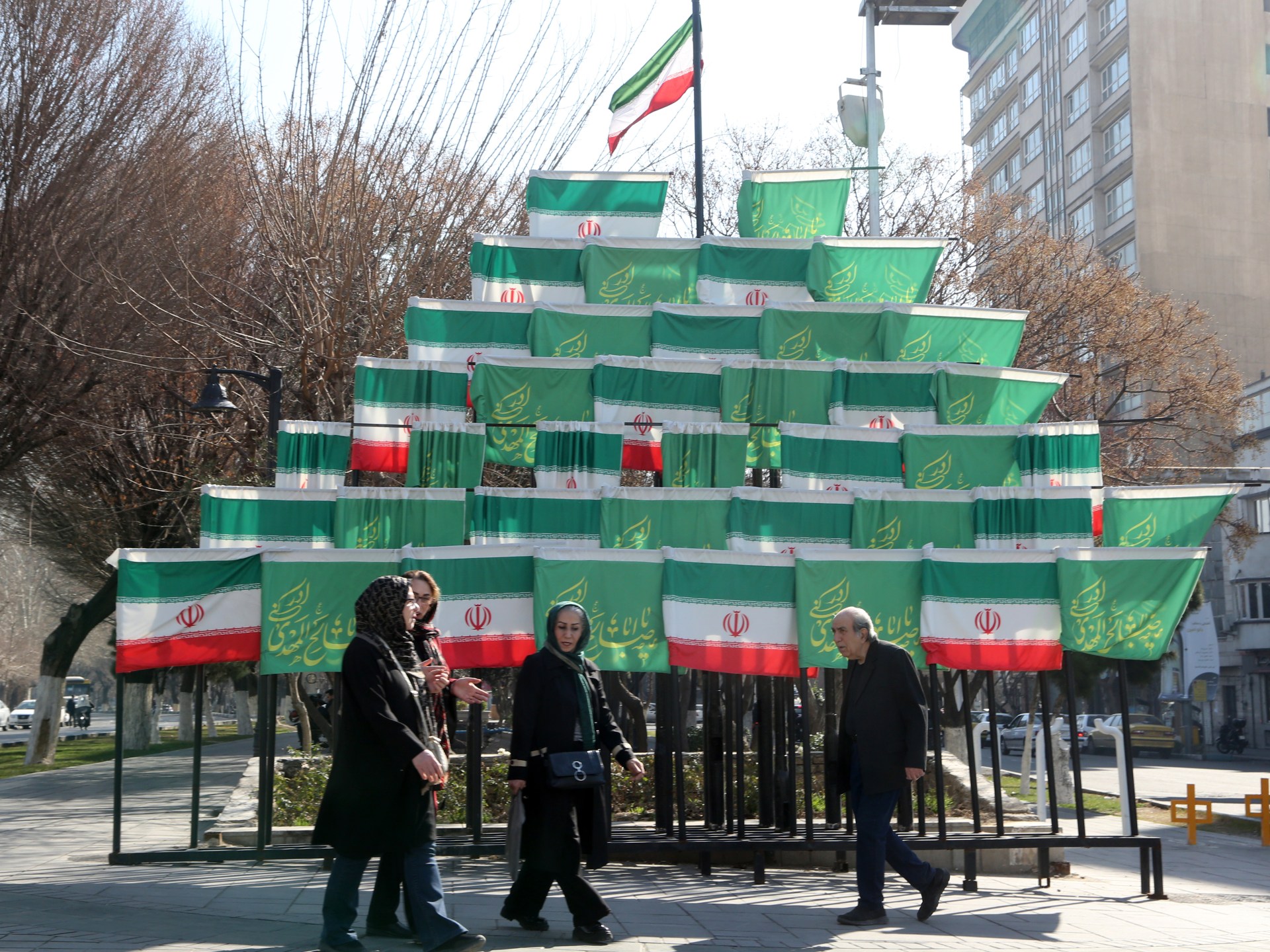

Tehran, Iran – Families across Iran have commemorated loved ones killed during nationwide protests last month, while teachers said school strikes were taking place to protest the killings.
Many attended ceremonies at Behesht-e Zahra, Tehran’s grand cemetery, on Tuesday and Wednesday, which marked 40 days – a traditional period of mourning – since the nights of January 8 and 9, when thousands were killed amid an unprecedented state-imposed internet and phone-service shutdown.
- list 1 of 3Ramadan begins in Palestine, Gulf; Egypt, Syria, more Muslim states to come
- list 2 of 3Washington appoints new US envoy on Tibetan human rights
- list 3 of 3Iran says ‘good progress’ made in nuclear talks with US in Geneva
end of list
Numerous videos have emerged online showing similar commemorations in many cities, including Lahijan to the north, Quchan and Mashhad in the northeast, Marvdasht in the south, and Najafabad in central Iran.
Chants of “for each person killed, thousands are behind them” could be heard in many of the ceremonies. Mourners spread flower petals, lit candles and somberly clapped in solidarity with the families.
At a ceremony on Tuesday to honour 19-year-old Sepehr Shokri, his father told gathered crowds, “Don’t talk of death, but of life and happiness”, as he said his son had laid down his life for his country.
The father had captured hearts last month after releasing an excruciating 12-minute video of himself searching for his son among numerous bodies of killed protesters laid out in the open at the courtyards and warehouses of the Kahrizak medical examiner’s office, on the outskirts of Tehran.
Some of the commemoration events took place in smaller cities and villages, like Abdanan in the western province of Ilam, where thousands had participated in protests last month. Multiple videos circulating online on Tuesday showed mourners running away in panic from the cemetery of the city as the sound of bullets rang out.
Advertisement
In the village of Chenar in the Asadabad area of western Hamadan province, people could be seen chanting “death to the dictator” as they marched to pay respects to a father and his 13-year-old son who were gunned down during the protests. Local reports said security forces deployed to the area with armoured vehicles, but officials have not commented.
‘Threats to students and teachers’
The Coordinating Council of Iranian Teachers’ Trade Associations, a non-governmental body, said on Wednesday that its call for school strikes on Tuesday and Wednesday had been backed by large numbers of teachers and students.
It said schools in the cities and towns of Shahr-e Rey, Baharestan, Pakdasht, Varamin, and Eslamshahr near Tehran were effectively shut due to the absence of students on Wednesday, while high school students in the town of Andisheh did not attend classes as a way to honour fellow students killed in the protests.
“These strikes occurred despite threats to students and teachers against striking from school principals, who themselves have been pressured by the Ministry of Education,” the group said, adding that at least 230 children and teenagers were killed last month.
Iran’s Justice Minister Amin Hossein Rahimi confirmed to state media on Wednesday that some of the children and teenagers arrested during the protests remain incarcerated. He said “many” minors have been released without saying how many were arrested.
Ehsan Azimirad, the spokesman of the parliament’s education commission, said that 17 percent of the participants in the nationwide protests were teenagers, many of them students.
“I have even heard that in some schools, an entire class had participated in the riots,” he said, adding that in some provinces, up to 45 percent of protesters were under 20 years old. Officials have previously said that most of the protesters across the country were in their 20s.
This comes amid widespread reports, also disseminated by some local media outlets, of a heavy presence of security forces near or inside schools in the aftermath of the protests. Some families have been concerned about sending their children to school.
Universities and dormitories have also become focus points for security forces, with reports indicating that some people have had their phones searched while others have been summoned for questioning. University students have also been among the large number of people arrested from their homes since last month. Iranian authorities have not released overall arrest figures.
Advertisement
A number of Tehran University students peacefully demonstrated on campus on Wednesday to observe the 40th day since the height of the protest killings.
Last month, members of the Basij – an Islamic Revolutionary Guard Corps (IRGC) paramilitary force – hung up a banner reading “Either death or Khamenei” at one of the entrances of the university, in support of 86-year-old Supreme Leader Ali Khamenei. Iranian authorities have also displayed a vehicle burned by “rioters” near another entrance.
Clashing versions of events
The Iranian government claims 3,117 people were killed during the unrest, saying that “terrorists” and “rioters” were behind the violence, and were armed and funded by the United States and Israel, which organised an ultimately failed “coup”.
A list of victims published by the government last month said 690 of those killed were “terrorists”, with others either civilians or security forces. But it did not say who was classified under which category, or exactly where, how, when or by whom they were killed.
The United Nations and international human rights organisations have blamed state forces for the widespread use of lethal force against protesters, and have called for the release of those arrested, including doctors and nurses who tried to help wounded protesters. The UN Human Rights Council adopted a censure resolution against Iran’s establishment last month.
The US-based Human Rights Activists News Agency says it has verified 7,015 deaths during the unrest and is investigating more than 11,700 other cases. Mai Sato, the UN special rapporteur on Iran, said last month that more than 20,000 civilians may have been killed as information remains limited amid access constraints.
The Iranian government on Tuesday and Wednesday held its own version of the 40th day ceremonies at the Grand Mosalla of Tehran, a huge mosque in the downtown part of the capital. A number of officials, including government spokeswoman Fatemeh Mohajerani, were in attendance.
On Tuesday, Iran’s supreme leader outlined his classification of the thousands killed during the nationwide protests, and divided them into several groups.
According to Khamenei, the first group are security forces, recognised as “the greatest of martyrs”.
The second were “passerby” civilians, he said. “Wherever this bullet [that killed them] may have come from, this incident occurred in the enemy’s sedition, and they are martyrs”.
“The third group are those who were deceived, who acted naively, who were inexperienced and went along with the seditionists,” Khamenei said, adding, “We ask forgiveness for them; they made mistakes”.
Outside of those three groups, however, were “corrupt individuals, seditionists, and coup plotters”, who Khamenei said “were consigned to hell”.
Related News
Italy probes suspect in Sarajevo ‘sniper tourism’ during Bosnia war: Report
Protesters clash with police over bid to restrict Argentina’s labour rights
Israel’s move to register land ‘systematises dispossession’ of Palestinians