
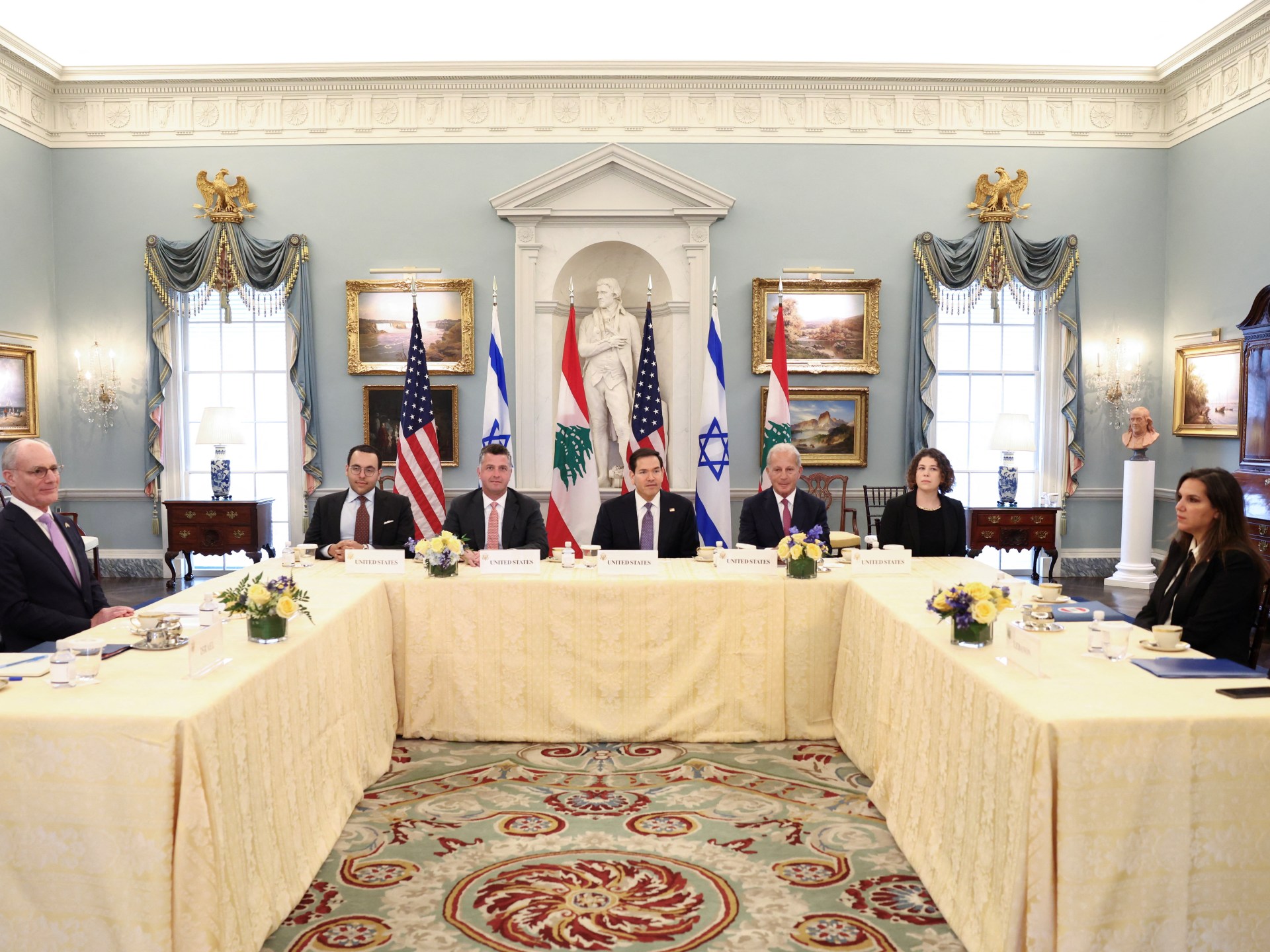

Israeli and Lebanese officials have held their first direct negotiations since 1983, as Israel continues its deadly military campaign against Hezbollah.
On Tuesday, both sides met in Washington, DC, and spoke for more than two hours in an event hosted by United States Secretary of State Marco Rubio.
- list 1 of 3Israel ‘wants to reach peace and normalisation with Lebanon’
- list 2 of 3Over-sold and under-delivered: Israel’s Netanyahu faces ceasefire backlash
- list 3 of 3Israeli ambassador: Lebanon wants to be liberated from Hezbollah
end of list
Israel’s ongoing military campaign in Lebanon has tested the fragile ceasefire struck on April 8, which paused the US and Israel’s war on Iran for two weeks.
Iran and ceasefire mediator Pakistan maintain that Lebanon was included in the initial ceasefire, while the US and Israel argue it was not.
At Tuesday’s meeting, the two sides entered with sharply different priorities. Israel ruled out discussing a ceasefire with Lebanon and instead pressed Beirut to disarm Hezbollah.
Lebanon, meanwhile, called for an end to the conflict, which has killed nearly 2,124 residents and displaced more than 1.1 million in its territory.
Both sides emerged, however, with positive remarks about the discussion.
Lebanon’s ambassador to the US, Nada Hamadeh Moawad, described the talks as “constructive”. But she added that she had called for a ceasefire, the ability for displaced people to return to their homes, and measures to ease the humanitarian crisis in her country.
Israel’s ambassador, Yechiel Leiter, called the discussions a “wonderful exchange”. He highlighted points of agreement, including a push to remove Hezbollah from Lebanon.
“The Lebanese government made it very clear that they will no longer be occupied by Hezbollah,” Leiter said. “Iran has been weakened. Hezbollah is dramatically weakened. This is an opportunity.”
Advertisement
Rubio, for his part, acknowledged the challenges ahead, telling reporters that progress would take time.
“We understand we’re working against decades of history and complexities,” he said.
Heavy fighting continues
Hezbollah opposed the direct talks and was not represented in the meeting. Instead, news reports suggested it stepped up its fire on northern Israel as the negotiations began.
The discussions come at a sensitive moment in the wider US-Israel war against Iran, as Tehran warns that continued attacks in Lebanon could endanger the week-old ceasefire.
The war began on February 28 with US and Israeli strikes on Iran. The start of the conflict sparked a new flurry of Hezbollah attacks on March 2, as part of a long-simmering conflict with Israel. Israel has responded with heavy bombardment ever since.
On April 8, shortly after the ceasefire with Iran was announced, Israel launched 100 air strikes across Lebanon, including in the heart of the capital, Beirut, killing more than 350 people. It was one of the deadliest days of the Israel-Lebanon war so far.
Despite Tuesday’s negotiations, there appeared to be no letup in the conflict. Al Jazeera correspondent Obaida Hitto, reporting from the Lebanese city of Tyre, said the violence had intensified throughout the day.
“There are continuing strikes going on in the southern parts of Lebanon,” he said.
He added that many had hoped Lebanon would be included in the ceasefire agreed upon with Iran, but that had not happened, leaving little optimism about a near-term end to the fighting.
Incoming fire, meanwhile, triggered drone and rocket alert sirens in Israeli communities near the Lebanese border. So far on Tuesday, Hezbollah has claimed 24 attacks on northern Israel and on Israeli troops in southern Lebanon.
‘Security zone’
Israel has invaded Lebanon multiple times over the decades, most recently in 2024.
Despite agreeing to withdraw its troops as part of a ceasefire that year, Israel has maintained a military presence in southern Lebanon. Hezbollah, an Iranian ally, has accused it of failing to abide by its commitments.
Some officials have said that Israel aims to establish a “security zone” stretching to the Litani River, about 30km (20 miles) from the border.
But critics argue its efforts are designed to further entrench its invasion and redraw its international border with Lebanon.
Israeli Minister of Defence Israel Katz has said that hundreds of thousands of displaced residents will not be allowed to return home until the area is demilitarised and northern Israeli communities are considered safe.
Advertisement
But Israel has faced war crimes accusations for levelling homes and entire villages in southern Lebanon, in violation of human rights law protecting civilian structures.
Despite suffering setbacks in its previous war with Israel, Hezbollah continues to launch daily drone, rocket and artillery attacks on northern Israel and Israeli troops in Lebanon.
The group also retains significant influence in parts of Lebanon, including Beirut’s southern suburbs and areas in the south and east.
While Hezbollah allies still hold cabinet positions, tensions have grown within Lebanon’s political leadership, with some criticising the group’s role in the conflict.
Related News
Strait of Hormuz leverage looms over US-Iran talks in Islamabad
Drone attack sparks fire on Kuwaiti tanker in UAE amid Iran’s Gulf attacks
Peru holds presidential election amid a decade of political tumult