

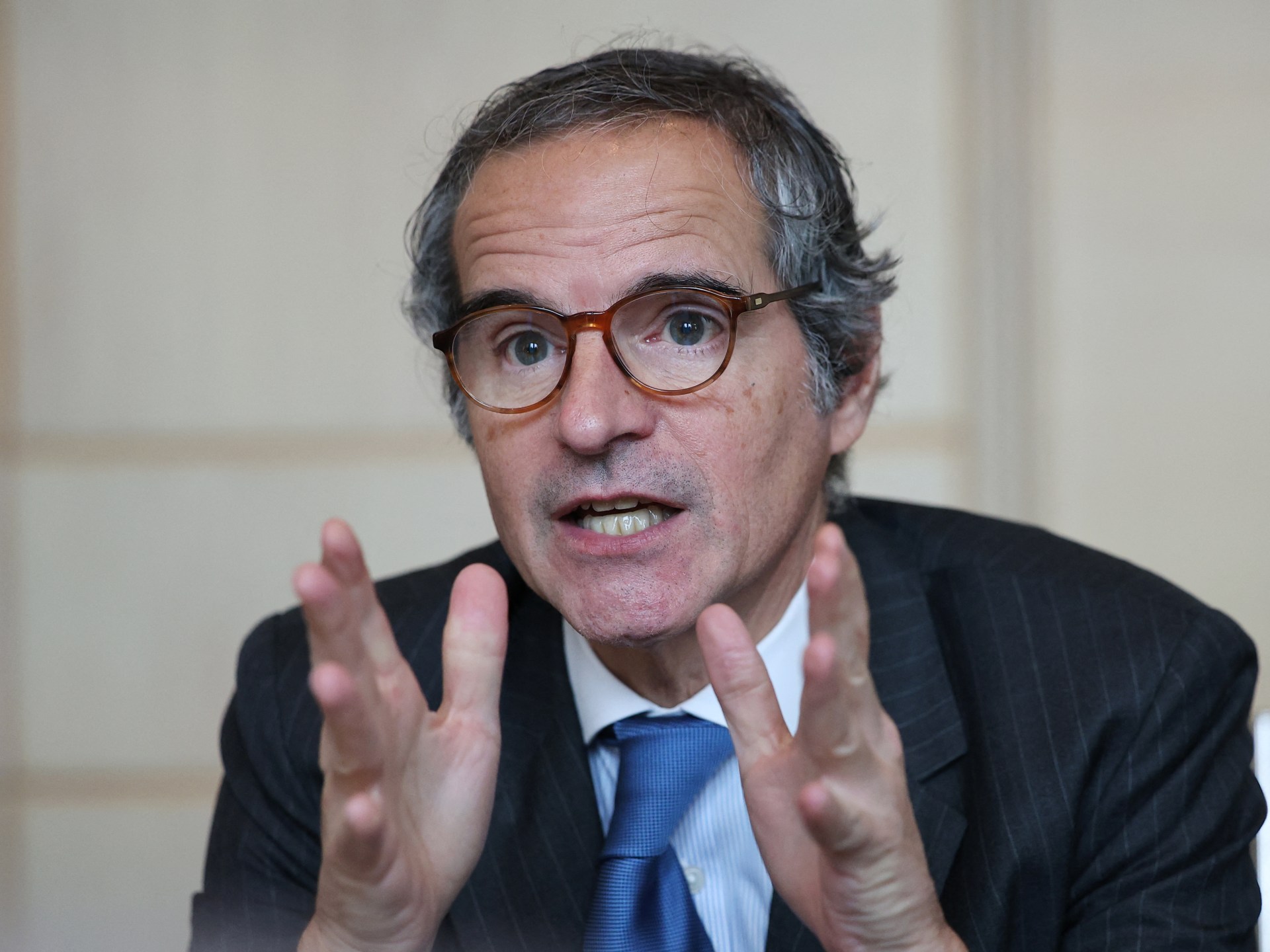

North Korea is showing a “very serious increase” in its ability to produce atomic weapons, according to Rafael Grossi, the head of the International Atomic Energy Agency (IAEA).
The diplomatically isolated country is believed to operate multiple facilities for enriching uranium, a key step in making nuclear warheads, South Korea’s spy agency has said. These include one at the Yongbyon nuclear site, which Pyongyang purportedly decommissioned after talks but later reactivated in 2021.
- list 1 of 4Kim Jong Un reappointed as president of North Korea
- list 2 of 4Kim Jong Un says North Korea will never give up on nuclear weapons
- list 3 of 4North Korea’s Kim meets Lukashenko, slams ‘pressure on Belarus from West’
- list 4 of 4North Korea keeping Iran at arm’s length, reports Seoul
end of list
“In our periodic assessments, we have been able to confirm that there’s a rapid increase in the operations” of the Yongbyon reactor, Grossi told reporters in Seoul on Wednesday.
The agency also observed a rise in operations at Yongbyon’s reprocessing unit and light-water reactor, as well as the activation of other facilities, Grossi said.
“All that points to a very serious increase in the capabilities of [the] DPRK in the area of nuclear weapons production, which is estimated at a few dozen warheads,” he said, using North Korea’s official name.
North Korea, which conducted its first nuclear test in 2006, is under a slew of United Nations sanctions for its banned weapons programmes.
It has declared that it will never surrender its nuclear weapons, and cut off access to IAEA inspectors in 2009.
The agency has noted the construction of a “new facility similar to the enrichment facility in Yongbyon”, Grossi said.
It was “not easy to calculate” any production increases without visiting the site.
Advertisement
However, “we consider, looking at external features of the facility, that there will be a significant increase in the enrichment capacity of the DPRK”, he said.
Asked whether Russia was assisting North Korea’s nuclear development, Grossi said the IAEA had not seen “anything in particular in that regard”.
North Korea has sent ground troops and artillery shells to support Russia’s invasion of Ukraine, and observers say Pyongyang is receiving military technology assistance from Moscow in return.
Related News
Indonesia, US sign ‘major’ defence cooperation agreement
‘Which interests being served by war?’ Iran’s Pezeshkian asks US public
Why an attack on Bushehr nuclear plant would be catastrophic for the Gulf