

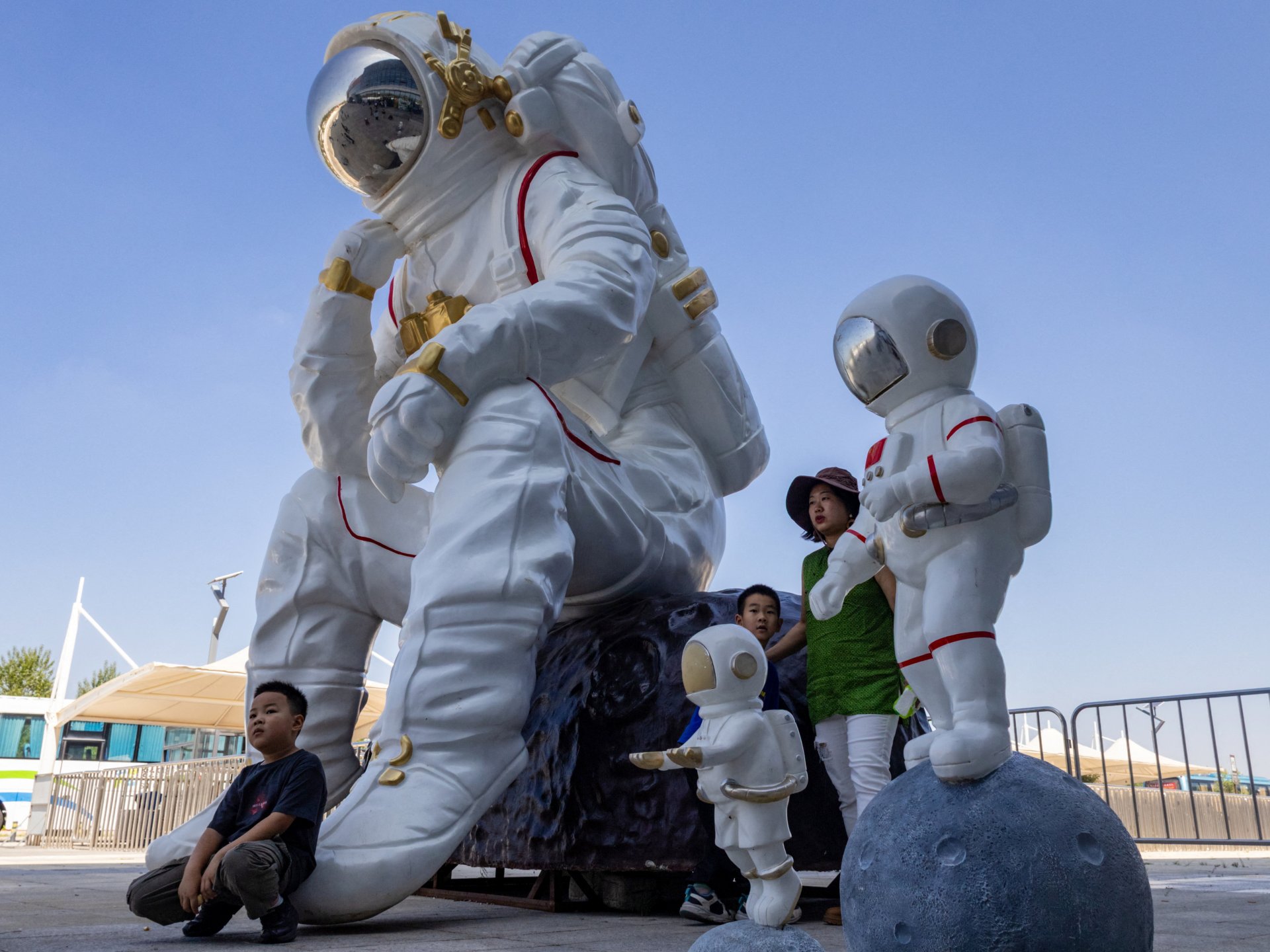

China’s Manned Space Agency has selected a Pakistani astronaut as a payload specialist for its upcoming Shenzhou-24 mission, making the unnamed individual the first foreign national to visit the country’s space station.
The Pakistani astronaut would join China’s Shenzhou-24 mission, as part of bilateral cooperation under Beijing’s Belt and Road Initiative, Chinese state media reported on Saturday.
- list 1 of 4Which countries have sent people to space?
- list 2 of 4Japan launches historic mission to bring back Mars moon samples
- list 3 of 4Why are US, Russia and China racing to put nuclear reactors on the moon?
- list 4 of 4‘Alien-cortical’ mice: Can human brain cells grow inside animals?
end of list
China has not identified the astronaut nor given a date of departure, but the mission is expected to take place by the end of the year.
Pakistani pilots Zeeshan Ali and Khurram Daud spent months training at the China Astronaut Research and Training Center in Beijing for a mission.
Last February, Pakistan and China, longstanding strategic and diplomatic partners, entered into an agreement, establishing a Chinese government-led programme to train Pakistani astronauts. China is Pakistan’s largest trading partner and a key foreign investor.
The China National Space Administration will also deploy Jinnah-1, Pakistan’s inaugural lunar rover. Weighing 35kg (77lb) and fitted with specialised scientific equipment, the rover is tasked with analysing plasma behaviour, radiation, and the composition of lunar soil.
The training programme includes practical operational exercises and intensive Chinese language lessons to prepare the candidates for the mission.
Beijing’s China Central Television reported that after completing a short-term in-orbit flight, the astronauts would return to Earth on board the Shenzhou-23 spacecraft.
China invested heavily in its space programme in recent years – catching up with its main rival, the United States – and aims to land astronauts on the Moon by 2030.
Advertisement
The US, Russia, and China are also racing to build nuclear reactors on the Moon. While the US space agency, NASA, announced plans to develop a nuclear reactor on the Moon by the end of 2030, Russia has been working with China and aims to do the same by 2036.
The reactors will be needed to power the mining of frozen water trapped deep in the moon’s craters, which scientists believe could supply drinking water, air, and rocket fuel for future bases. The reactors would also provide power for lunar bases.
Related News
Trump defends Russian sanctions relief, lashes out at Zelenskyy
‘Who will represent us?’ Palestinians react to election delay

What is ranked-choice voting and how does it work in US elections?