

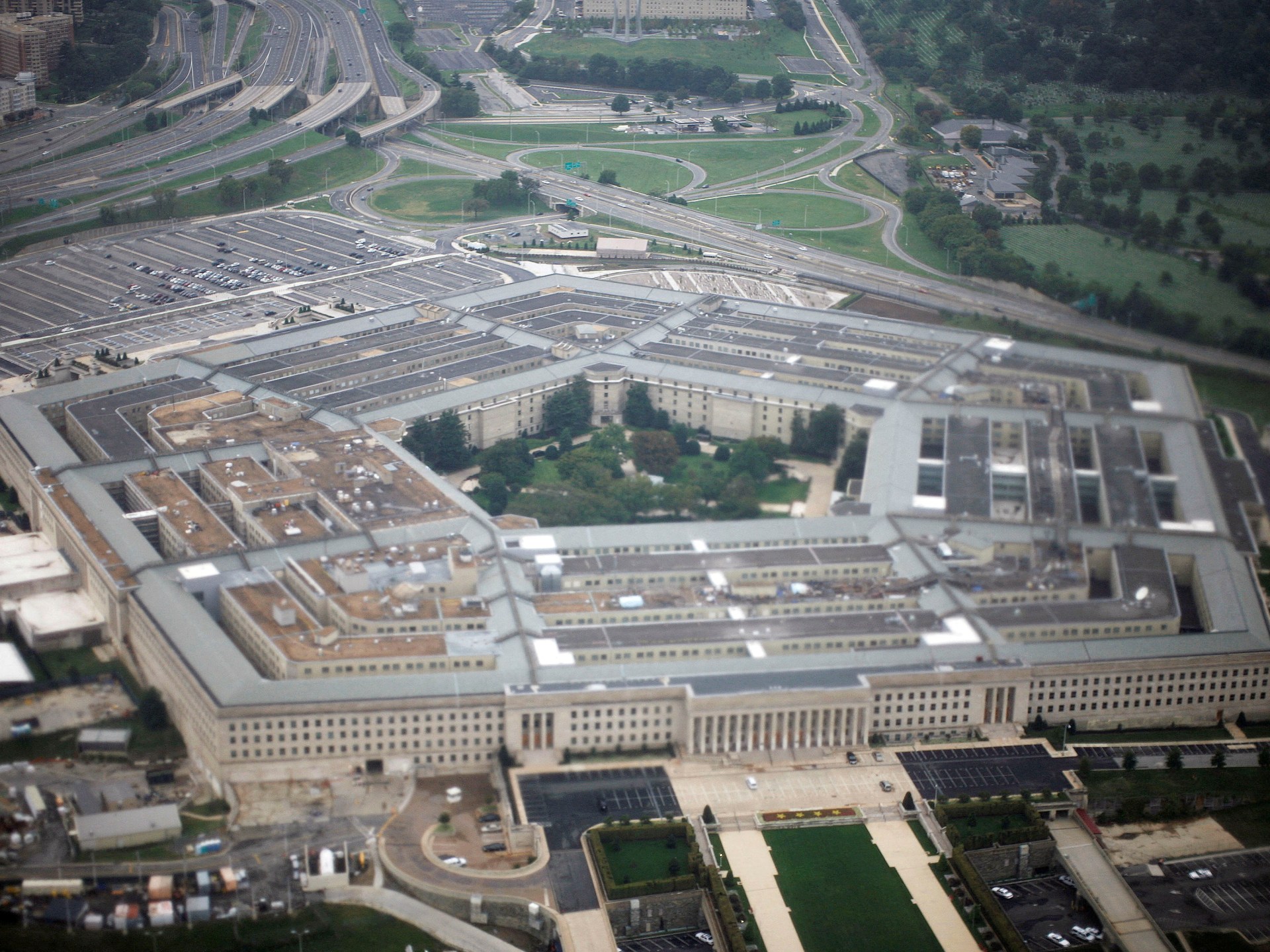

United States President Donald Trump has asked for a nearly 40 percent increase in military spending over last year in his annual budget request, which totals $1.5 trillion.
While the budget request released on Friday is not legally binding, it underscores the White House’s priorities, with its heavy emphasis on military spending and law enforcement.
- list 1 of 3Trump’s primetime speech on Iran war: Key takeaways
- list 2 of 3‘Bomb back to the Stone Age’: US history of threats and carpet bombing
- list 3 of 3Can the US seize Iran’s enriched uranium – and what are the risks?
end of list
“The 2027 Budget builds on the President’s vision by continuing to constrain non-defense spending and reform the Federal Government,” Russell Vought, the director of the Office of Management and Budget, said in the proposal’s preface.
The heightened spending, according to the document, “advances President Trump’s delivery of peace through strength by reinvesting in the foundations of American military power”.
The budget is expected to be the subject of lengthy congressional negotiations in the weeks to come.
The $1.5 trillion request involves an increase of about $455bn over fiscal year 2026. It is separate from an emergency request of $200bn that the Trump administration requested from Congress to support the US-Israeli war with Iran, which began on February 28.
That previous demand had already roiled some standard-bearers in Trump’s “Make America Great Again” (MAGA) base, who argued that diverting more money to the conflict ran against the president’s “America First” pledges.
The budget outline includes a proposed $73bn in cuts to domestic programmes.
That includes initiatives to counter climate change and boost renewable energy, as well as a slate of programmes meant to assure equality and access in housing, education and healthcare. Funding for refugee resettlement and aid programmes are also slated to be pared down.
Advertisement
Instead, funding would be used to build Trump’s Golden Dome missile defence system, invest in critical minerals, boost US shipbuilding, and raise salaries for US troops, according to a White House fact sheet.
Speaking at a private White House event on Wednesday, Trump underscored his desire to grow the US military, while shifting some federal programmes, including the Medicaid and Medicare healthcare programmes, to the states.
Critics have warned that the move could lead to inconsistent funding and possible shortages.
“We’re fighting wars. We can’t take care of day care,” Trump said at the private event, as reported by The Associated Press news agency.
“It’s not possible for us to take care of day care, Medicaid, Medicare — all these individual things,” he said. “They can do it on a state basis. You can’t do it on a federal.”
US military expenditures have ticked up in recent decades, climbing from about $320bn in 2000 to $997bn in 2024, according to the Stockholm International Peace Research Institute.
The US regularly spends more on its military than the total of the next nine countries combined, according to the Peter G Peterson Foundation, an organisation that assesses US fiscal challenges.
The US has also historically devoted a larger percentage of its gross domestic product (GDP) to the military than the other top economies in the world.
The budget request is also designed to bolster several of Trump’s other top priorities.
It calls for continued funding for the Department of Homeland Security (DHS) and its subsidiary agency, Immigration and Customs Enforcement (ICE), to support his mass deportation campaign.
That comes as Congress continues to be stuck in a deadlock over funding ICE and Customs and Border Patrol (CBP), two DHS agencies that Democrats have refused to support without reforms.
The request also calls for a 13 percent increase for the Department of Justice, which the White House said would focus on violent crime, and a $10bn fund within the National Park Service for beautification projects in the capital, Washington, DC.
In the request, the administration also laid out a path to pass the budget that would rely heavily on Republicans in Congress.
It suggested $1.1 trillion of the defence funding could be approved via the regular appropriations process, which would most likely require bipartisan support.
The other $350bn could be passed through a mechanism known as reconciliation, which typically can be achieved with a simple majority. Republicans hold a slim majority in both the US Senate and House of Representatives.
Advertisement
The US regularly runs annual deficits of about $2 trillion, with the national debt currently sitting at about $39 trillion.
Related News

Iran’s IRGC claims attacks on UAE, Bahrain aluminium facilities

‘I don’t know how we’ll emerge from this’: How much more can Israelis take?

Iran ‘hits’ US AWACS, air tankers: What else has it targeted in past month?