
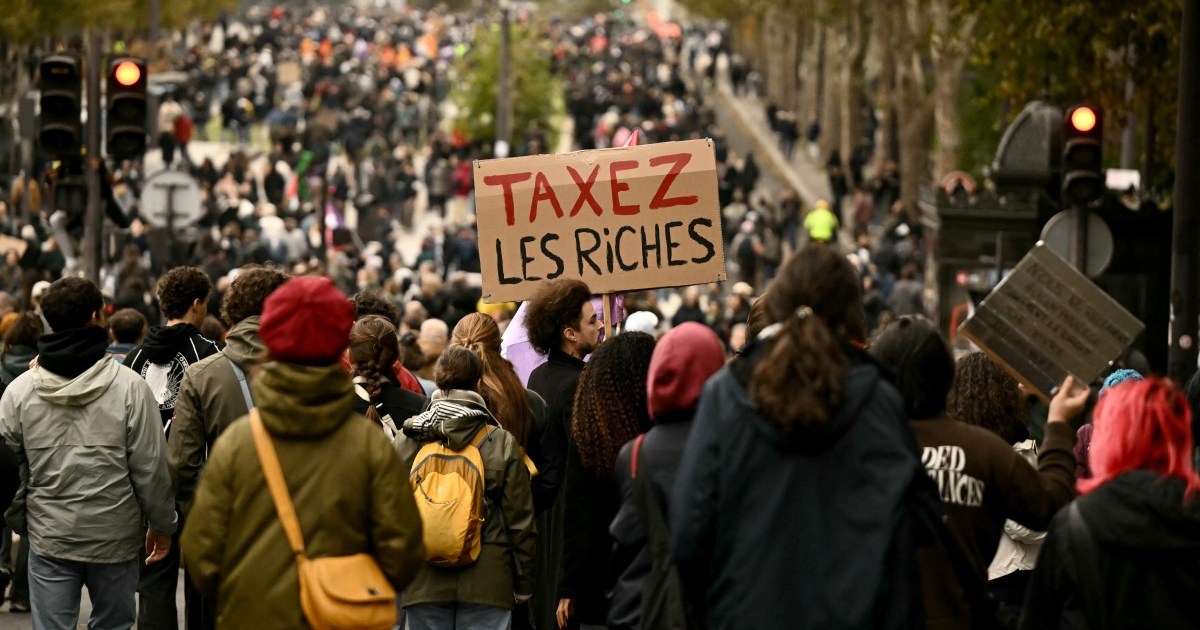

Young people in France continued their nationwide protests over the weekend, demanding better education facilities and a promising future amid the rising cost of living in the country.
France’s Ministry of Interior said 410,000 people protested nationwide on Saturday, including 110,000 in Paris, as the government has struggled to address the issues raised by the student-led protests.
- list 1 of 3Can protests in Europe bring about change?
- list 2 of 3Marine Le Pen vows French ‘renaissance’ as far right eyes seat of power
- list 3 of 3The French government is hiding behind a ‘riots’ narrative
end of list
France was also roiled by nearly two years of protests beginning in 2018 over the high cost of living and opposition to French President Emmanuel Macron’s economic policies. Those protests, which were led by the Yellow Vests movement, demanded that the government address the rising economic inequality, boost welfare and public services, and tax the rich.
As the young protesters take to the streets, many of the old demands remain unfulfilled. So, why have French politicians been unable to address the issues facing the country?
Here’s what we know:
Why are young people in France protesting now?
The youth-led protests in France erupted last month amid deteriorating conditions in schools, broader economic anxieties and opposition to government budget cuts.
The protests began in mid-September after high school students blockaded campuses over overcrowded classrooms (often 32–35 pupils per room), unreplaced teacher absences, and dilapidated building infrastructure.
Protesters have waved placards reading statements like “We have a future to build, not to endure”, as they expressed frustration with shrinking public resources and state investment.
Advertisement
Teachers have also joined the students protesting over low salaries. French teachers are paid less on average than their counterparts in other European countries like Germany, according to the Organisation for Economic Co-operation and Development’s Education at a Glance 2026 report.
School teachers in France earn a gross salary of 41,968 euros ($46,900) per annum compared with 69,453 euros ($77,700) for their German counterparts. Social taxes, high pension contributions and the rising cost of living eat into their monthly income.
What started as a localised strike over school resources has since drawn in trade unions as well as civil servants, and the protests have evolved into a broader economic and political crisis.
This is due to discontent over the government’s proposed 54-billion-euro ($60bn) package of cost-cutting and tax measures for the 2027 budget, which includes civil servant salary freezes.
Students and youth fear bearing the brunt of public spending reductions amid a multidecade high in poverty rates and rising costs of living, exacerbated by the United States-Israel war on Iran.
Currently, according to Amine Snoussi, a journalist for Le Media TV and a former parliamentary assistant at the French National Assembly, the condition of public high schools is dire since government money is being spent elsewhere.
“Students are studying in cold, dirty buildings, some of them infested with rats. In some schools, absent teachers haven’t been replaced for over six months. And all of this is happening while thousands of teaching jobs are being cut, and while public money keeps flowing to private schools. That’s what lit the fuse,” he told Al Jazeera.
What has been the government’s response?
The French government has responded to the mass protests by imposing curfews and deploying police across the country to crack down on protesters.
President Macron has blamed ultra-left groups for trying to “bring down the Republic” and threatened accountability for those involved in violence.
On Friday, the French leader met representatives of the student movement for the first time since the protests began.
But the meeting failed to defuse tensions, with student representatives calling for further mobilisation until the government presents concrete actions.
On Monday, during a visit to Marseille, Macron said he has “asked the government to address the legitimate demands at the root of this protest movement”.
The government is also expected to announce changes to Parcoursup, France’s national online university admissions platform, according to French media reports.
Advertisement
Why is the French government struggling to address protesters’ demands?
Analysts say the French government is struggling to address students’ demands due to a severe fiscal crisis and planned budget cuts, which have led to a drop in the country’s education budget.
According to data published by French economist and co-director of the World Inequality Lab Lucas Chancel, “The public budget for higher education, student life, and research (relative to the total number of students in France, once inflation is taken into account) has decreased by 20 percent since 2017.”
The French government has defended the budget cuts.
In an address to the nation on October 7, French Prime Minister Sebastien Lecornu acknowledged that “the anger among young people didn’t come out of nowhere” and promised the government would present a plan to address the crisis by the end of October.
The French prime minister has also asked his ministers to check spending as France’s national debt has ballooned to about 3.6 trillion euros ($4 trillion), which is equivalent to 119 percent of the country’s gross domestic product (GDP).
Of greater concern to markets than the total debt is France’s growing deficit, however, which is expected to reach 5.4 percent of GDP in 2026 – far above the European Union average of just more than 3 percent. This is the amount by which a government’s spending exceeds its income.
But in a report, French economist and professor Thomas Piketty noted that while public debt has increased, the country’s private wealth has also grown from “300 percent to 600 percent of GDP, with extreme concentration among the wealthiest financial fortunes”.
“In other words, France has never been richer. The problem to solve is simply one of distribution,” he added.
Does France have a wealth distribution problem?
France has relatively low to moderate income inequality, but wealth redistribution has been an issue of debate, particularly in left-wing political groups.
People aged 60 and older, who form a quarter of the population, own 60 percent of the country’s wealth (non-financial and financial), according to a January 2026 review by prominent French economic policy think tank OFCE.
A huge chunk of government funds go to service social security.
A government report seen by the Reuters news agency earlier this month also noted that nearly one-third of some French ministries’ budgets pay for the pensions of retired civil servants, which reduces spending on education and other priorities.
Snoussi told Al Jazeera that the wealth distribution question has always been central to current French politics.
“Macron is called the rich people’s president for a reason. He always supports rich people and has never managed to create a form of equality between classes,” he said.
Macron has been branded “the president of the rich” for cutting the wealth tax. He has also faced criticism for his economic policies aimed at modernising the economy and creating jobs. His decision to impose a fuel tax triggered the 2018 so-called Yellow Vests protests, a grassroots movement seeking government intervention to address inequality.
Advertisement
Critics say his policies resulted in redistribution of wealth upward and affected the working-class population. But Macron has defended his policies, particularly his decision on wealth tax, saying that forcing the wealthy out of the country won’t help the poor.
“I don’t believe in this French jealousy which says, ‘There are rich people; let’s tax them and we will all feel better,’” he told The New York Times in a 2017 interview.
Antonio Fatas, a professor of economics at INSEAD in Fontainebleau, France, told Al Jazeera: “France has a more redistributive system than other European countries – at least similar”.
He explained that redistribution is a set of programmes of taxes and transfers that redistribute income from high-income individuals towards lower-income individuals.
The real issue, Fatas said, is deeper.
“France’s growth has been limited for years. With low growth, it is not hard to imagine parts of the population that are unhappy with the progress they see, and this leads to demands for a solution in the form of government support or redistribution,” he said.
France is currently facing significant fiscal stress, with its annual budget deficit forecast at 5.4 percent of its GDP, well above the standard European Union ceiling of 3 percent. The country also remains heavily backed by its public sector, with state expenditures consuming roughly 57 percent of its total GDP – including a notable 14 percent allocated strictly towards worker pensions.
“The assumption is that someone out there is rich enough that they can be taxed. While I can imagine in a more progressive system in France, one has to be careful about the limitations of these apparent solutions,” Fatas added.
So how should the government respond?
In his opinion column for the French newspaper Le Monde, Piketty wrote that reinvesting in sectors like education and health should be the government’s priority.
“Reinvesting in these sectors today is not simply a matter of equality between regions or social classes,” he wrote, highlighting that such reinvestment would help an economy produce greater output by using fewer resources.
Snoussi shared a similar view.
“The government has a simple choice: invest, or step aside,” he said.
“But the real question is whether Macron even wants a way out. Or is he hoping the situation gets worse, so he can crush the movement through police and judicial repression?”
Fatas, the economics professor, noted that while there are a lot of good things people in France want the government to do, it is important to prioritise which sector requires funding.
“The government spending [in France] is the largest among advanced economies, so there is little room to just spend the way out of this.
“France faces a political paralysis when it comes to reform decisions, and this is the reason why they are in a more difficult situation than others,” he added.
Related News
Italy and Spain lift border controls after months of tension over Ceuta

Meta faces Australian lawsuit over alleged social media harm to children
European, Middle East ministers urge US-Iran diplomacy, not new attacks