

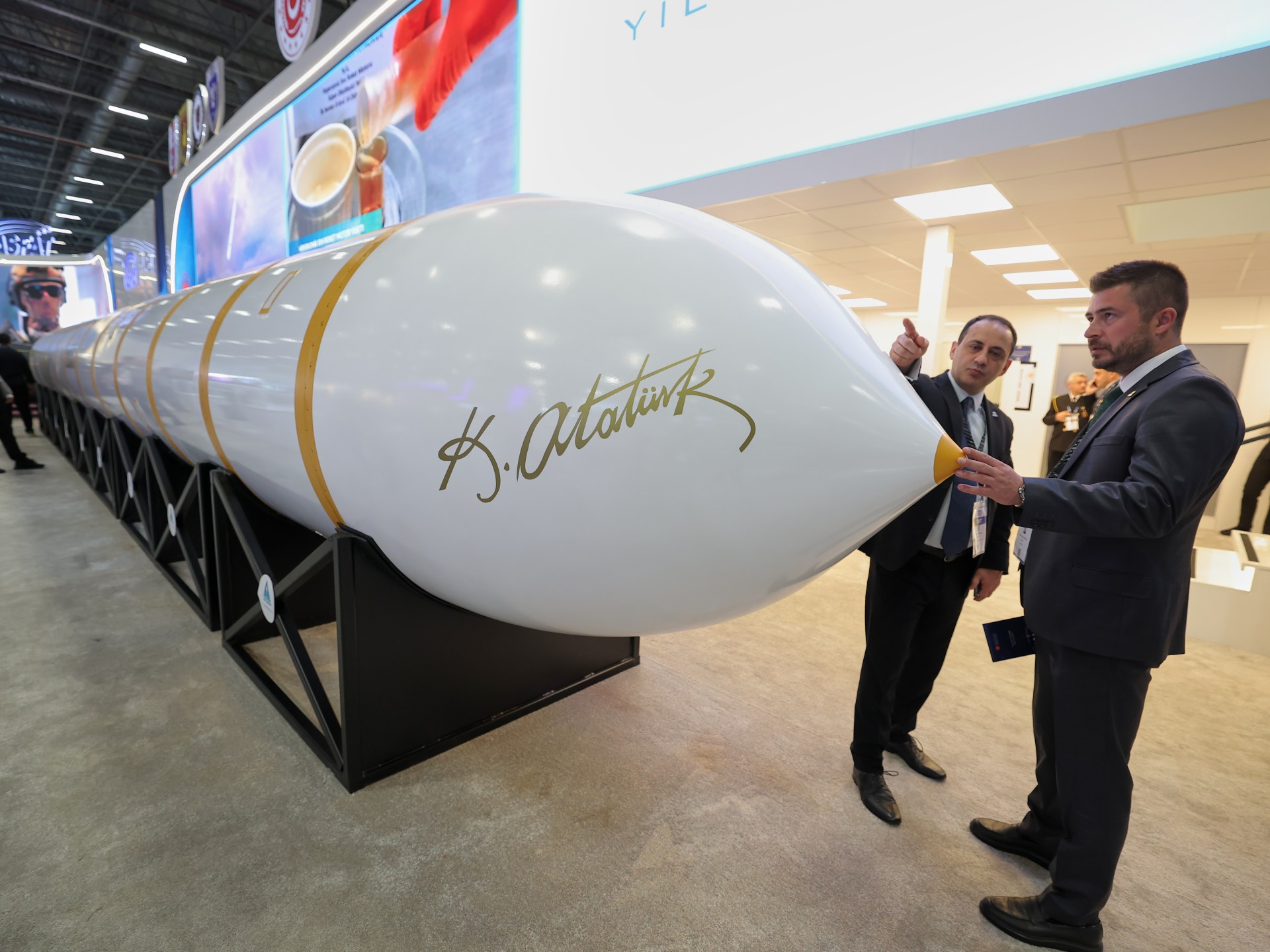

Turkiye has unveiled a prototype of an intercontinental ballistic missile (ICBM) as part of a push to become self-reliant and to gain a foothold as a key defence player in the Middle East and among its NATO allies.
The ICBM, named Yildirimhan, meaning “lightning” in Turkish and developed by the Defence Ministry’s research and development centre, was unveiled on Tuesday at the SAHA 2026 Defence and Aerospace Exhibition at the Istanbul Expo Centre.
- list 1 of 3Is Turkiye Israel’s next target in the Middle East?
- list 2 of 3Turkish authorities arrest three defence executives accused of spying
- list 3 of 3Turkey on alert as Iran conflict escalates, warns against provocations
end of list
Why is this ICBM model significant, and what does it mean for Turkiye’s defence industry? Here’s what we know:
The Yildirimhan has a range of 6,000km (3,278 miles). According to the Federation of American Scientists, ballistic missiles with a range exceeding 5,500km (roughly 3,418 miles) are classed as ICBMs. If launched from Turkiye, the Yildirimhan will be able to hit targets across Europe, Africa and Asia.
According to the Turkish news agency Anadolu, the ICBM’s maximum speed is Mach 25, which is 25 times the speed of sound. It has four rocket propulsion engines and is fuelled by liquid nitrogen tetroxide. Its warhead has a payload capacity of 3,000kg.
Turkiye has not begun the production of the missile yet.
Addressing the exhibition in Istanbul on Tuesday, Defence Minister Yasar Guler said, “In this era where economic cost has become an asymmetric weapon, Turkiye offers its allies not only weapon systems but also technology and a sustainable security economy.”
Experts underlined the significance of the ICBM.
Advertisement
Ozgur Unluhisarcikli, regional director at the German Marshall Fund of the United States think tank, told Al Jazeera, “In my view, Turkiye does not need ICBMs to deter any immediate security threat it is facing. Therefore, it is not the ICBM, but the capability to produce it that is significant for Turkiye.”
Ali Bakir, a senior nonresident fellow at the Middle East Council on Global Affairs, said the prototype marks a breakthrough for Ankara.
“This development symbolises a leap in its missile capabilities and technological advancement, enabling Turkiye to join the exclusive ranks of a handful of countries possessing such advanced defensive technologies,” he told Al Jazeera.
“Furthermore, this milestone underscores Ankara’s commitment not only to enhance its military power and defensive capabilities but also to strengthen its deterrence, positioning itself as a key ultra-regional power,” Bakir added.
Why has Turkiye developed Yildirimhan?
The unveiling of the new missile comes amid serious tensions in the Middle East. While a fragile ceasefire between the warring sides in the US-Israel war on Iran holds following six weeks of strikes, a naval battle is playing out in the Gulf as Tehran continues to block the Strait of Hormuz and the US enforces a naval blockade of Iranian ports. Meanwhile, Israel continues to violate “ceasefires” reached in Lebanon and the Gaza Strip.
In March, when Iran was retaliating against the US-Israeli strikes by attacking US military assets and infrastructure in the Middle East, Ankara reported that NATO’s air defences shot down ballistic missiles fired towards Turkiye on March 4 and 9. Tehran denied firing any missiles at Turkiye and suggested Israel could be behind them as acts of sabotage.
In February, just days before the US-Israel war on Iran began, former Israeli Prime Minister Naftali Bennett, whose party is projected to do well in the national election this year, was the latest prominent politician to declare Turkiye a threat to Israel.
Speaking at a conference, Bennett said Israel must not “turn a blind eye” to Turkiye, accusing it of being part of a regional axis “similar to the Iranian one”.
“A new Turkish threat is emerging,” Bennett said. “We must act in different ways, but simultaneously against the threat from Tehran and against the hostility from Ankara.”
Other Israeli politicians have made similar comments in the past few months. Turkiye, which has been seen as growing closer to other regional powers, including Saudi Arabia and Egypt, has strongly criticised Israel’s genocidal war on Gaza as well as violence inflicted on Palestinians in the occupied West Bank by Israeli settlers, often with support from Israeli forces.
Advertisement
While Israel has had an openly antagonistic relationship with Iran since the 1979 Islamic revolution, Israel-Turkiye relations have taken a more pragmatic line. However, since coming to power in the early 2000s, Turkish President Recep Tayyip Erdogan has been increasingly critical of Israel.
“The blood-stained genocide network continues to kill innocent children, women, and civilians without any rule or principle, ignoring all kinds of human values,” Erdogan said about Israel while addressing an international conference in Istanbul in April.
Bakir told Al Jazeera that fears around Israel are not the main factor behind the development of the ICBM, but the timing and nature of Turkiye’s advances with ballistic missiles are clearly intended to send messages to both allies and adversaries, including to “an increasingly hegemonic, expansive and aggressive Israel”.
“This development aligns with the long-term vision of the Justice and Development Party [AKP] and President Erdogan to reduce reliance on foreign defence equipment, increase self-sufficiency and establish a robust domestic defence industry that meets global standards,” he said.
“This initiative aims to address national needs, strengthen the country’s strategic autonomy, and tackle regional and international threats to Ankara’s national security and interests. This policy is proactive rather than reactionary,” Bakir added.
According to Turkiye’s Hurriyet Daily News, unveiling the ICBM, the defence minister said recent conflicts, such as Russia’s war on Ukraine and the US-Israel war on Iran, have had an impact on the global security scenario.
“These conflicts and wars have provided very critical data for security doctrine while also increasing our responsibilities,” Guler said.
German Marshall Fund’s Unluhisarcikli said the volatility in the region and the direct and indirect security challenges Turkiye is facing as a result are the main reasons for enhancing its military capabilities.
“Other factors that should be considered are Turkiye’s commitment as a NATO ally to increase its defence spending to 5 percent of its GDP, export-oriented defence industrial policy, using defence cooperation as a tool of diplomacy and using defence industry as a catalyst to upgrading the technological intensity of its overall industrial production,” he added.
In June last year, leaders from the 32-member military bloc pledged to allocate up to 5 percent of their gross domestic product (GDP) to defence and related sectors by 2035, describing the move as a “quantum leap” in collective security. The pledge was made in a NATO summit communique agreed in The Hague, and US President Donald Trump, who has repeatedly pushed for a higher NATO defence spending commitment, took credit for the shift.
Turkiye is home to NATO’s second-largest standing army and has emerged as a notable weapons exporter.
It has sought military self-sufficiency for some time, a gradual process that saw it establish the Defence Industry Development and Support Administration Office (SaGeB) in 1985.
Advertisement
For years, SaGeB focused on international collaboration in research and development. But as Turkiye came up against restrictions on what weapons it could buy and how it could use them, it switched to local production.
In the 2010s, it started focusing on domestic design, resulting in a huge increase in domestic defence production.
“Turkiye is doing what all NATO allies have agreed to do at The Hague Summit – to increase defence spending to 5 percent of their GDPs,” Uluhisarcikli said.
“Moreover, Turkiye is a critical ally in NATO’s southern flank and pivotal in securing the Black Sea-Mediterranean connection through the Turkish Straits. Therefore, a stronger Turkiye means a stronger NATO,” he added.
Today, thousands of Turkish defence manufacturers span land, air, and naval capabilities, something which is being increasingly recognised internationally.
According to local media reports, the country’s defence and aerospace exports reached an all-time high of $10.05bn in 2025.
Believed to be the most famous Turkish unmanned aerial vehicle (UAV), the Bayraktar TB2 is one of the most widely bought Turkish defence products.
According to the Stockholm International Peace Research Institute (SIPRI), Turkiye’s main customers during 2021-24 were the United Arab Emirates, Pakistan and Qatar.
As for its most famous export, the Bayraktar medium-altitude long-endurance drone has reportedly been exported to at least 31 countries, including Iraq, Ukraine, Kenya, Bangladesh and Japan.
Related News

US issues new Cuba sanctions as UN experts warn of ‘energy starvation’

India loses its last left-wing government after five decades

Cuban man is 18th person to die in US ICE custody this year: Monitor