
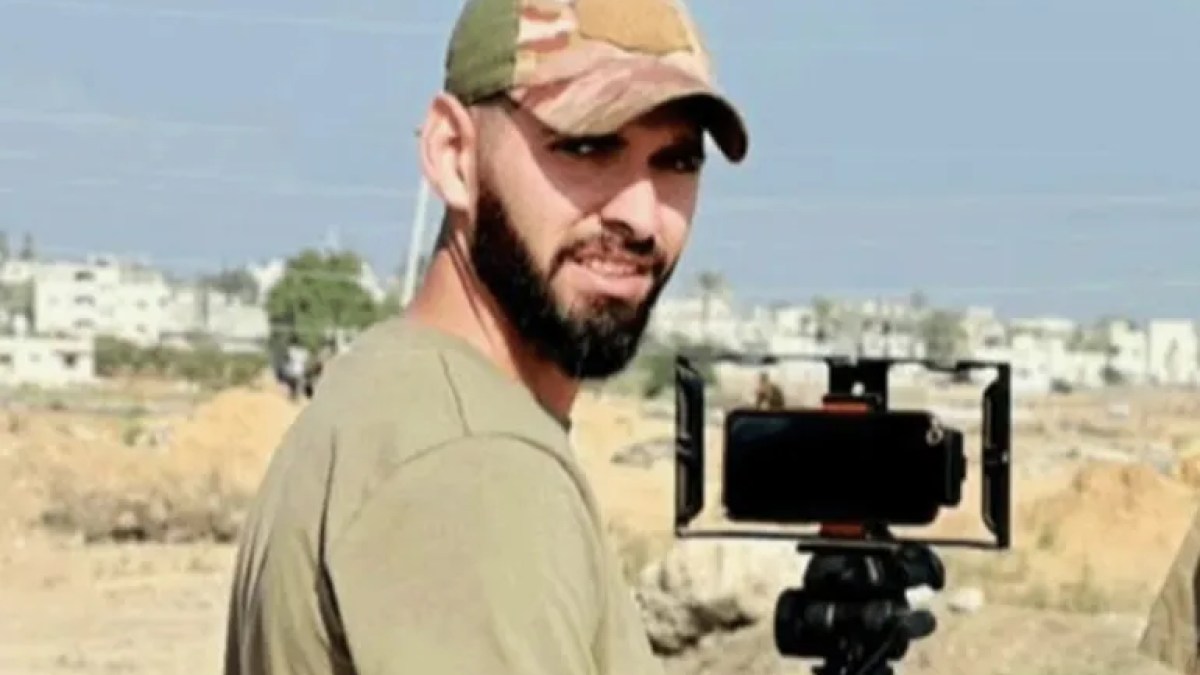

Al Jazeera journalist Ahmed Wishah was killed on Saturday in Gaza’s Bureij refugee camp weeks after his brother Mohammed Wishah, who also worked for the Doha-based Network, was killed in a deliberate Israeli shelling on his car.
Ahmed in his mid-20s is the 12th Al Jazeera journalist to have been killed by Israel in Gaza, which has become the deadliest place for journalists in the world. At least 260 Palestinian journalists have been killed since Israel launched war in October 2023, according to the Committee to Protect journalists.
- list 1 of 3Mona Khalil, Lebanon’s turtle advocate, dies after Israeli attack
- list 2 of 3Parents and two daughters among 10 killed in Israeli attacks on Gaza
- list 3 of 3MSF says conditions in Lebanon’s Nabatieh resemble a ‘death trap’
end of list
Ahmed, who worked as a cameraman for Al Jazeera Mubasher channel, was killed when an Israeli air attack hit a house. Two other Palestinians were also killed in the strike as Israel has continued its attacks despite the October 2025 ceasefire.
Who was Ahmed and what has Israel said about his killing?
Here’s what we know:
Who was Ahmed?
Born in the al-Bureij refugee camp in central Gaza, Ahmed Samir Mohammed Wishah was the youngest of three brothers. He worked as a cameraman for Al Jazeera Mubasher.
Ahmed gained prominence during the Israeli war on the Gaza Strip by accompanying and filming footage for his late brother, Al Jazeera Mubasher correspondent Mohammed, who was killed on April 8 in Israeli shelling.
Together, they formed a media duo that documented the suffering of the Palestinian people and the unfolding events of the war.
In an interview following his brother’s death, Ahmed called on the world to stop the killing of journalists.
“Let the martyrdom of Mohammed Wishah be the end to the killing of journalists. This is my message to the world. Someone should stop the occupation from targeting journalists. That’s our only message. Stop the Israeli occupation from targeting journalists,” Ahmed had said in April.
Advertisement
Ahmed’s dedication to his brother extended far beyond his journalistic duties.
After Mohammed’s death he also took care of his late brother’s children and took on additional responsibilities with family.
Talal Mahmoud, an Al Jazeera Mubasher correspondent in Gaza, recalled his close ties with the two brothers.
“I’ve known Ahmed since the beginning of the war. He was always present, accompanying his brother Mohammed in the tent where he stayed,” Mahmoud said.
“Given our shared work, we frequently gathered in that tent at Al-Aqsa Martyrs Hospital or Al-Awda Hospital in Nuseirat camp, exchanging thoughts and discussing the details of our coverage.”
“He became not just a friend, but a colleague at the same channel. He would often accompany me on assignments, documenting the events we covered throughout the long months of this war.”
Mahmoud also shared a poignant story from just days before Ahmed’s death.
“My last encounter with Ahmed was a few days ago when he told us his mother wanted to prepare a meal in memory of his martyred brother, Mohammed. He brought us Maftoul [a traditional Palestinian dish], saying, ‘This is from my mother, a mercy offering for the soul of my brother Mohammed. Please pray for him.'”
“We ate until we were full, and we prayed fervently for Mohammed’s mercy and forgiveness,” Mahmoud reflected.
Mohammad Al-Akhras, a photojournalist working with CGTN, the English-language news channel of state-run China Global Television Network remembered Ahmed as “a kind, gentle, and deeply principled person who brought a cheerful spirit to his colleagues.”
“He worked with genuine passion, and his ultimate goal in his coverage was to convey the people’s message and their suffering.”
“He always spoke of martyrdom and paradise. Whenever we jokingly asked him, ‘Don’t you want to get married? Don’t you want us to celebrate you?’ he would simply reply, ‘My wedding will be in paradise.’ He attained exactly what he asked for.”
“As journalists, we walk this path of martyrdom because the Israeli targeting of the press has become a systematic routine,” Al-Akhras noted.
“The occupation wants to assassinate the image, assassinate the truth, and obscure reality.”
‘Smearing of killed Palestinian journalists’
In a statement to the AFP news agency on Saturday, an Israeli military spokesman made a similar allegation about Ahmed Wishah, accusing him, without providing evidence, of being a “Hamas terrorist”.
But in a statement, Al Jazeera refuted that accusation as “baseless”, saying that the Israeli military has “relentlessly spread false allegations” against its staff to “justify its crimes against Al Jazeera journalists and cameramen in Gaza”.
Advertisement
“These attempts deceive no one and cannot obscure the truth witnessed by the world,” the media network said, calling it a “smear campaign”.
The Committee to Protect Journalists (CPJ) has previously condemned Israel’s “smearing of killed Palestinian journalists”, with the press freedom group saying it had documented a pattern of Israel “accusing journalists of being terrorists without producing credible evidence”.
In its statement Saturday, Al Jazeera said it is determined “to take every available legal measure to prosecute the perpetrators” of the “crimes” against its staff in Gaza.
It added that it remains committed to covering events in the enclave despite the Israeli military’s “attempts to silence the voice of truth”.
Related News
Colombians to vote in presidential run-off pitting leftist against hardliner
Thai Princess Bajrakitiyabha dies at 47 after three years in coma
World Cup 2026: What time can fans in Europe, Middle East and Africa watch?