Cuba closes Quito embassy after Ecuador’s Daniel Noboa expels its diplomats
 06 March 2026
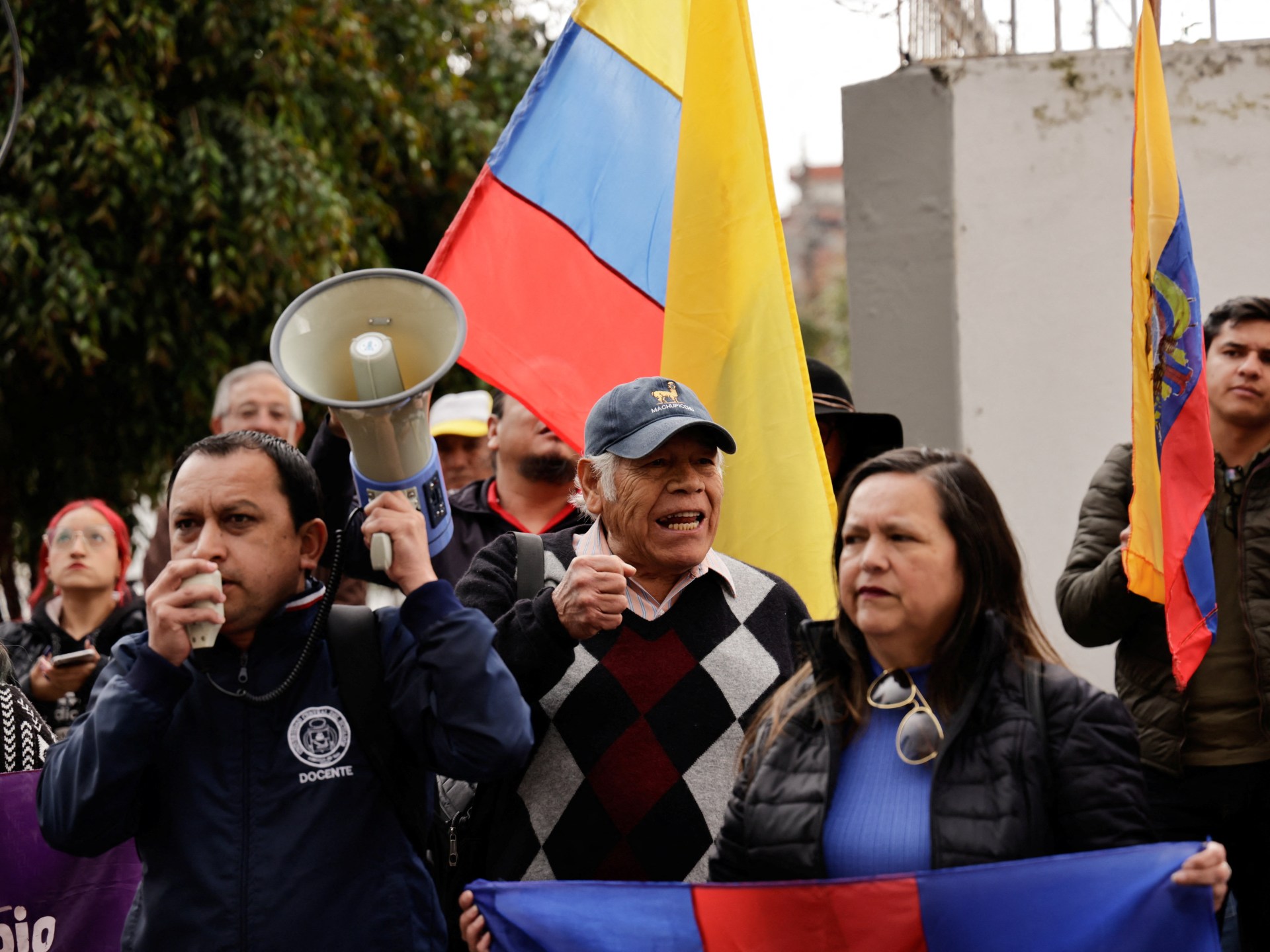

Cuba has shuttered its embassy in the Ecuadorian capital of Quito, after it was given 48 hours to withdraw its diplomatic personnel.
In a communique published on Friday, the Cuban Ministry of Foreign Affairs, known by the acronym Minrex, criticised the 48-hour deadline as unfair and denounced the decision to expel its diplomats.
- list 1 of 3Cuba hit by massive power outage amid US oil pressure
- list 2 of 3Cuba’s economy on edge: Fuel shortages and rising hardship
- list 3 of 3Trump says regime change in Cuba is ‘question of time’ after Iran
end of list
“The Cuban government deeply regrets the unilateral and unfriendly action of the Ecuadorian government, which undermines the spirit of respect and cooperation that has historically characterised bilateral relations between the two countries,” it said in a statement.
The communique confirmed that the Quito embassy ceased operations at 10am local time (15:00 GMT).
The closure marks an abrupt fracture in diplomatic relations between Cuba and Ecuador, as right-wing President Daniel Noboa takes a hardline stance on left-wing governments in the region.
On Wednesday, in a letter to the Cuban embassy, Noboa’s government declared all Cuban diplomatic and consular personnel in Ecuador persona non grata.
The letter explained that the “government of Ecuador grants a period of 48 hours” for Cuban Ambassador Basilio Antonio Gutierrez Garcia and his colleagues to leave the South American country.
It included no explanation for the sudden request.
Increasing pressure on Cuba
The Cuban government, however, responded to the demand with outrage, though it ultimately complied.
On social media, Cuban President Miguel Diaz-Canel criticised Noboa’s government, though he added that the Ecuadorian people “can always count on Cuba’s affection and support”.
Advertisement
“We reject the unjustified, hostile, and unfriendly actions of the Ecuadorian government toward our diplomatic mission accredited to that nation,” Diaz-Canel wrote.
“This unprecedented action damages the historic relations of friendship and cooperation between our peoples.”
He added that Cuba would continue to rally for “the preservation of Latin American unity”, despite Ecuador’s “clear policy of submitting to imperial interests”.
The remarks seem to be a reference to the tightening relations between Noboa and United States President Donald Trump, who has repeatedly expressed a desire to see Cuba’s communist government fall.
Just this week, Trump told the news outlet CNN that he planned to focus on regime change in Havana after he closes his current war with Iran.
“Cuba is going to fall too. They want to make a deal so badly,” Trump told CNN host Dana Bash.
“We’re really focused on this one right now,” he said of Iran. “We’ve got plenty of time, but Cuba’s ready.”
In late February, Trump told reporters on the White House lawn that it was possible the US could “end up having a friendly takeover of Cuba”, though it was unclear what that might look like.
He has also signalled that Secretary of State Marco Rubio — a Cuban American who has been hawkish against Havana’s government — would lead efforts to transform the leadership on the Caribbean island.
Trump and Noboa build relations
Noboa has forged tight relations with Trump. Just this week, his government announced a joint operation with the US government to combat cartels in Ecuador, part of a widening anti-drug campaign under Trump.
And this weekend, Noboa is travelling to South Florida to meet with Trump at his Mar-a-Lago estate, along with other right-wing Latin American leaders. They have called their meeting the “Shield of the Americas” summit.
Already, Trump has launched deadly military operations in several parts of Latin America and threatened further involvement in countries like Mexico and Cuba.
Since September, the US has conducted at least 44 air strikes on boats and maritime vessels in the Caribbean Sea and eastern Pacific Ocean, accusing them of smuggling drugs, though no public evidence has been produced to justify that assertion.
In January, Trump also authorised an attack on Venezuela to abduct its leader at the time, President Nicolas Maduro, and transport him to the US to face drug-trafficking charges.
As part of his national security strategy, Trump has argued that the US should “restore American preeminence in the Western Hemisphere”.
Advertisement
In a social media post earlier this year, the US Department of State put it more bluntly: “This is OUR Hemisphere, and President Trump will not allow our security to be threatened.”
Noboa has mirrored several of Trump’s policy stances, as his own country struggles with an uptick in violent crime in the wake of the COVID-19 pandemic.
Like Trump, for instance, he has repeatedly criticised the left-wing government in Colombia for failing to take more aggressive action against the illicit manufacture of cocaine within its borders.
In recent weeks, Noboa also slapped 50 percent tariffs on Colombia, echoing Trump’s own use of the import tax to enforce compliance with his foreign policy goals.
A policy of isolation
Noboa’s decision this week to expel Cuban diplomats coincides with Trump’s push to further isolate the Caribbean island from other countries in Latin America.
Since January’s attack on Venezuela, Trump has severed the flow of oil and money between the governments in Caracas and Havana.
Then, on January 29, Trump issued an executive order threatening economic penalties against any country that provides Cuba with oil, whether directly or indirectly.
The policy, which critics describe as tantamount to an oil blockade, comes on top of a full trade embargo the US has imposed on Cuba since the 1960s.
That Cold War-era embargo has been credited with weakening Cuba’s economy, and with the country cut off from the oil supplies that power its electrical grid, the United Nations has warned the island could be on the precipice of humanitarian “collapse”.
The US, however, has justified the embargo as necessary to confront Cuba over its violations of human rights. Though Democratic President Barack Obama sought to ease the restrictions against Cuba in 2015, Trump reimposed the sanctions upon taking office for a first term in 2017.
Noboa marked this week’s expulsion of the Cuban diplomats from Ecuador with a short social media video, showing an embassy worker dropping papers into a rooftop incinerator.
He captioned the video with a short comment, describing the scene as a “parrillada de papeles”, or a barbecue of papers.
Related News
White House post after US hockey win over Canada stirs controversy
Army helicopter crashes into Iran market, killing 2 pilots and 2 merchants
Mapping Russian attacks and territorial gains across Ukraine