Devastation and frozen frontlines: Ukraine marks four years of Russia’s war
 24 February 2026
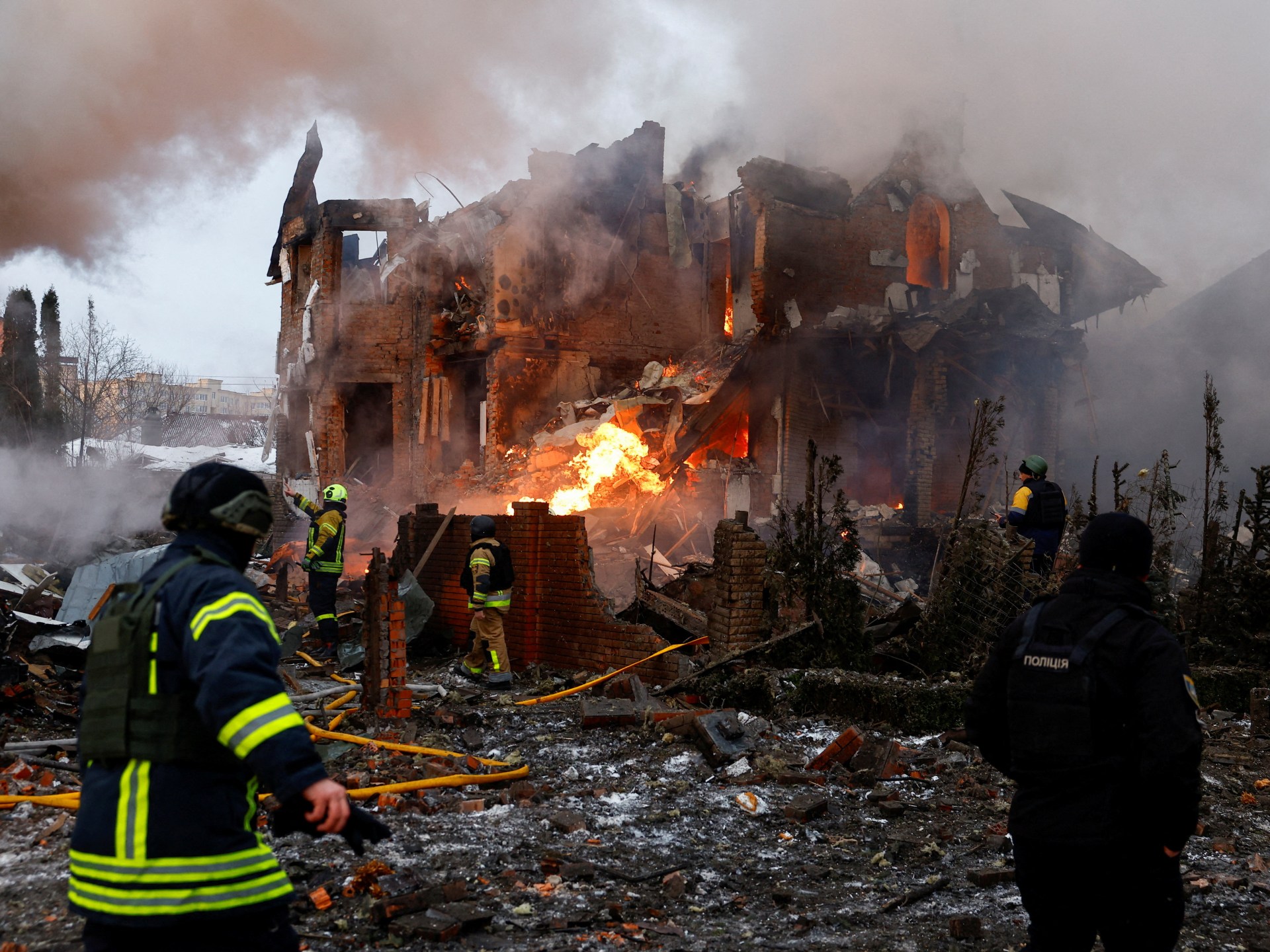

Kyiv, Ukraine – Hennady Kolesnik never expected the full-scale Russian invasion to last this long.
“These are the worst and longest years of my life,” the 71-year-old retired welder told Al Jazeera four years after the aggression that began on February 24, 2022.
- list 1 of 4‘You either fight or die’: Kenyans tricked into joining Russia-Ukraine war
- list 2 of 4How four years of war in Ukraine have changed Russia
- list 3 of 4The Ukraine war in numbers: People, territory, money
- list 4 of 4Putin’s strategy is that Ukraine will fall before he does: Ex-FM Kuleba
end of list
In the first days of the war, he and many Ukrainians were afraid Kyiv would be lost, as well as the third of their France-sized nation that lies on the left, eastern bank of the Dnipro River.
Tens of thousands of Russian troops, including elite airborne units and motor rifle brigades, occupied north of the Kyiv region, while the Kremlin’s supporters triumphantly touted that the capital would be seized “within three days”.
Months later, “we were ecstatic about what we’d regained” after Russian forces withdrew from around Kyiv and were ousted from northern Ukraine, said Kolesnik, a grey-haired, pallid-faced and emaciated pensioner, clutching a cane.
He is recovering from a case of pneumonia that he feared he would not survive amid days-long power outages and disruptions of central heating caused by Russian drones and missiles during a cold spell, when temperatures plunged to as low as -23 degrees Celsius (-9.4 degrees Fahrenheit).
“But we’re still standing, and that’s the most important thing in a fight,” Kolesnik, who used to dabble in boxing, said with a smile.
His wife, Marina, 70, agreed: “Nobody expected us to last that long, and we’re still here.”

However, Ukraine’s 2023 counteroffensive failed to cut Moscow’s “land bridge” from western Russia to annexed Crimea, and Russian troops keep inching forward.
Advertisement
But their advance is glacial amid staggering losses. Last year, they occupied less than 5,000 square kilometres (1,930 sq miles), or about 0.8 percent of Ukraine’s total area, according to Ukrainian officials and Western analysts.
Overall, Russia controls about 19 percent of Ukraine’s territory.
“The front line froze like during World War I,” Nikolay Mitrokhin of Germany’s Bremen University told Al Jazeera. “So far, Russia doesn’t have enough forces or new technologies for a decisive and successful advance, but it can still squander thousands of [its soldiers’] lives.”
This month, Russian forces encountered a dual communication problem that reversed their progress.
Elon Musk’s SpaceX company shut down smuggled Starlink satellite internet terminals used by Russian soldiers, while Moscow’s efforts to block the Telegram messaging app further disrupted coordination.
Ukrainian forces counterattacked, regaining about 200 sq km (77 sq miles) in the eastern Zaporizhia and Dnipropetrovsk regions.
But in other front-line areas, the pressure is mounting.
Russian drones with attached optic fibre immune to jamming began reaching a heavily-fortified town in the southeastern Donetsk region.
“It has gotten a lot noisier. There are more outages; some locals are panicking,” Sviatoslav, a serviceman stationed in Kramatorsk, told Al Jazeera. He withheld his last name in accordance with wartime protocol.
Moscow insists Kyiv surrender Kramatorsk and the rest of Donetsk – about 1,000 sq km (386 sq miles).
What could affect Ukraine’s stance is further Russian strikes on energy infrastructure.
“Ukraine keeps the front line well, but the functionality of its energy system is hanging by a thread, which may affect a lot,” Mitrokhin said.
Eighty-eight percent of Ukrainians think Russia’s strikes are designed to “force them to capitulate”, according to a survey by the Kyiv International Sociology Institute (KMIS) conducted in late January.
Nevertheless, two-thirds of those polled said Ukraine’s armed forces should fight for “as long as it takes”.
“People en masse are more ready to keep resisting [the invasion] than to capitulate,” Svetlana Chunikhina, vice president of the Association of Political Psychologists, a Kyiv-based group, told Al Jazeera.
And even though there is a spike in depression, anxiety, and chronic stress among Ukrainians, there are no “abrupt jumps” in these conditions, she said.
“People adapt – including through depression – to the war’s horrible circumstances; people keep functioning,” she said.
Ukrainians still hope for a better future, she said.
Advertisement
Only one in five polled Ukrainians hopes the war will end this year, but two in three are sure that in 10 years, Ukraine will be a “thriving” member of the European Union.
“This is the literal realisation of the philosophic principle: ‘get ready for the worst, hope for the best,’” Chunikhina said.
However, brain fog and cynicism are on the rise, she said.
“For the Ukrainian public whose fight against the Russian aggression is largely fuelled by moral virtues – including high ones, such as altruism, patriotism, responsibility to future generations – cynicism could be really destructive,” she said.
News brings little relief.
United States President Donald Trump has so far failed to deliver on his pre-election pledge to end the war “in 24 hours”.
Meanwhile, Russian public figures who support the Kremlin still try to present the invasion as a step to “protect” Russian-speaking Ukrainians.
Moscow-based analyst Sergey Markov claims that the war began on February 23, 2014, when pro-Russian protesters began rallying in Crimea, urging the Kremlin to annex the Ukrainian peninsula.
“It was a peaceful uprising of the Russian people for freedom, peace and true democracy,” he wrote on Telegram on Monday.
Related News
Palestine urges ‘powerful partners’ to stop Israel’s West Bank ‘annexation’
At least 37 killed in Nigeria mine carbon monoxide poisoning: Reports
Israeli settlers deface, set fire to West Bank mosque during Ramadan