


The United States-Israeli war on Iran has exposed the vulnerability of critical water infrastructure in a region that is among the most water-scarce in the world.
This week, Iran’s foreign minister accused the US of striking a desalination plant on Qeshm Island off the coast of Iran in the Strait of Hormuz. The strike reportedly cut off the water supply to 30 villages. Just 24 hours later, Bahrain said an Iranian drone had caused material damage to one of its desalination plants near Muharraq.
The six Gulf states – Bahrain, Kuwait, Oman, Qatar, Saudi Arabia and the United Arab Emirates – are among the most water-scarce countries in the world and rely heavily on desalination to meet the needs of their combined populations, which exceed 62 million people.
In this visual explainer, Al Jazeera unpacks how dependent the region is on desalination, how much water is produced each year and how various desalination processes work.
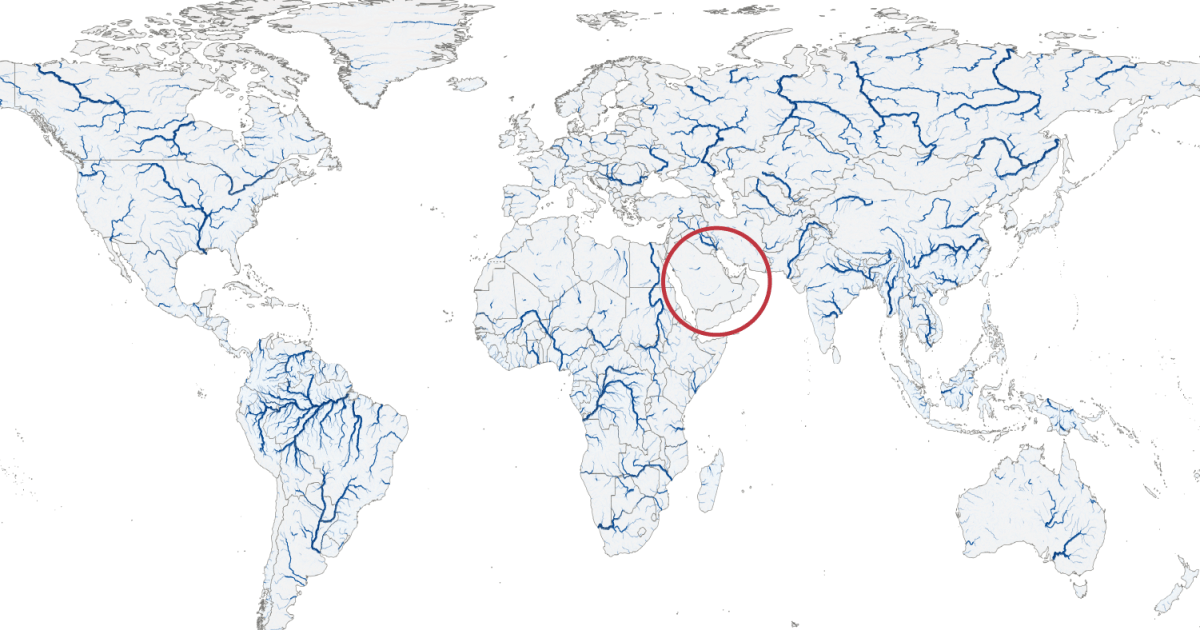
The Gulf has no permanent rivers
The Gulf states are deserts with no permanent rivers. While they lack rivers, they do have seasonal waterways called wadis, which carry water during rare rainfall.
These nations rely primarily on groundwater and desalination to supply water to their rapidly growing cities, industrial zones and agricultural areas.
The map below shows the major rivers and waterways in areas surrounding the Gulf.

7.2 trillion litres from desalination
The Gulf countries produce roughly 40 percent of the world’s desalinated water, operating more than 400 desalination plants along their coasts.
Advertisement
The threshold the United Nations has set for absolute water scarcity is 500 cubic metres (655 cubic yards) per capita per year.
With an average per-capita share of natural freshwater of only 120 cubic metres (155 cubic yards) per year, therefore, Gulf countries rely heavily on desalination to fill the gap between supply and demand.
According to a 2023 report from the GCC Statistical Center, the six Gulf states produced 7.2 billion cubic metres, or 1.9 trillion gallons, of freshwater through desalination. This volume translates to about 122 cubic metres per capita per year, or about 334 litres (88 gallons) per day. However, their total installed capacity is much higher, estimated at 26.4 billion cubic metres annually.
One billion cubic metres is equivalent to one trillion litres.
The largest and most populous of the states – with 37 million inhabitants – is Saudi Arabia. It produced 3 billion cubic metres of desalinated water in 2023, followed by the UAE with 1.9 billion cubic metres, Kuwait with 0.8 billion cubic metres, Qatar with 0.7 billion cubic metres, Oman with 0.5 billion cubic metres and Bahrain with 0.3 billion cubic metres.

Limited rainfall, the absence of permanent rivers and depletion of groundwater reserves have rendered natural freshwater resources insufficient for the rapidly growing populations of the Gulf.
Without desalination, water for drinking and for industrial and agricultural purposes would be impossible to maintain. According to data from the GCC Statistical Centre on water production and consumption, here is the reliance on desalination for total water supply in each country:

Qatar
At 61 percent, Qatar is the most dependent of the Gulf states on water from desalination. About 22 percent of its combined 1.1 billion cubic metres of annual water supply comes from groundwater and 18 percent from rainwater. However, when it comes to drinking water alone, Qatar relies nearly exclusively on desalination, which constitutes more than 99 percent of its drinking water supply for its 3.2 million people.
Bahrain
Bahrain is the second most dependent on desalinated water with 59 percent of its total 0.5 billion cubic metres of annual national water supply coming from desalination. For drinking water, this figure jumps to more than 90 percent. Additionally, 32 percent comes from groundwater and 11 percent from rainwater, respectively, for its 1.6 million inhabitants.
Kuwait
Kuwait follows with 47 percent of its 1.7 billion cubic metres of water used annually obtained through desalination while 51 percent comes from groundwater with rainfall making up the remainder.
Advertisement
The UAE
The UAE has a roughly equal mix with 41 percent of its water derived from desalination and 46 percent from groundwater with the remainder coming from rainwater and treated wastewater. This totals 4.8 billion cubic metres annually for its 11.5 million inhabitants.
Oman
Oman produces 23 percent of its total 2.2 billion cubic metres annually from desalination for its 4.7 million inhabitants, followed by groundwater at 69 percent with the remainder coming from rainfall and treated wastewater.
Saudi Arabia
Saudi Arabia produces more desalinated water than any other country, but with 18 percent of its total usage coming from desalination, Saudi Arabia is the least dependent of the Gulf states on water from desalination, relying instead on groundwater for 79 percent of its total water needs. Rainfall accounts for the remainder of the 17.3 billion cubic metres the kingdom produces annually for its 37 million inhabitants.
How desalination works
Desalination is the process of removing salt and minerals from seawater to make it suitable for human consumption and irrigation. This is primarily achieved through thermal distillation or reverse osmosis.
Historically, the only way to desalinate water was to boil it and then collect the steam to obtain freshwater, which is essentially how thermal distillation works.
Seawater is pumped into desalination plants. From there, filters remove sand, algae and particles before the water is heated until it forms steam, leaving salt and minerals behind. The steam is then cooled and condenses into pure distilled water. After this, minerals are added, and the water is disinfected to ensure it is safe for drinking. Finally, the water is pumped into municipal pipelines or bottled for use in homes, businesses and industries.
Reverse osmosis, on the other hand, uses high-pressure pumps to force seawater through a semipermeable membrane that captures salt and minerals while allowing water molecules to pass through.
This method has become the more popular form of desalination because it is significantly cheaper to operate, uses less energy and does not cause thermal pollution through the discharge of hot water into the sea.

Related News
Iran war: What is happening on day 13 of US-Israel attacks?

South Sudan at risk of ‘return to full-scale war’, UN warns

The Royal Lodge: Epstein’s links to ex-Prince Andrew’s financial meetings