
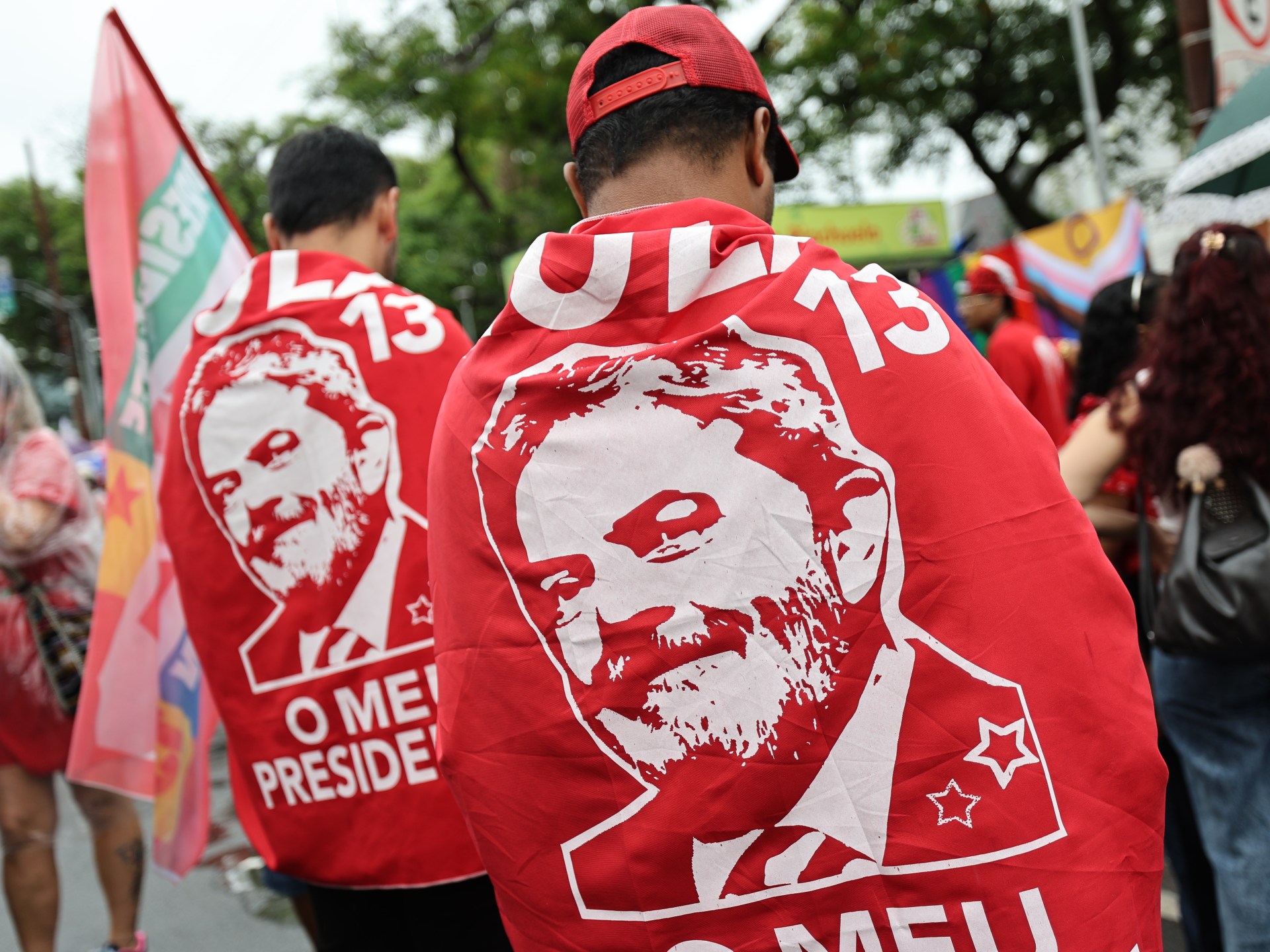

Another poll has shown leftist Brazilian President Luiz Inacio Lula da Silva trailing behind right-wing Senator Flavio Bolsonaro in the October 25 run-off election.
The survey, released by CNT/MDA on Friday, showed Bolsonaro taking 46.8 percent of the vote, compared with 45.9 percent for Lula.
- list 1 of 3The media battle behind Brazil’s election
- list 2 of 3A political dynasty? Why the Bolsonaro family dominates Brazil’s right wing
- list 3 of 3Brazilian government calls for probe into US funding of far-right causes
end of list
The latest projection comes a day after a Quaest poll found Bolsonaro carrying 46 percent of the vote, compared with Lula’s 44 percent. A separate Datafolha poll found Bolsonaro taking 47 percent of the vote against Lula’s 45, down from 49 percent a week earlier.
All three polls currently fall within a 2 percent margin of error, meaning the race is still considered by many experts to be a toss-up. Still, they underscore an uncomfortable political climate for Lula, who had a month ago been projected to easily sail to victory at the ballot box.
That was before Bolsonaro, the son of former President Jair Bolsonaro, took the most votes out of any candidate in the first round of voting on October 4.
Bolsonaro won 56,104,503 votes compared with Lula’s 53,879,538.
The senator has hewed closely to the political persona of his father, who has been barred from running for re-election until 2030 after an electoral court ruled he abused his authority to cast doubt on the 2022 presidential election.
The elder Bolsonaro has remained under house arrest while serving a 27-year sentence connected to efforts to overturn the 2022 vote, which he lost to Lula.
Flavio Bolsonaro, 42, has pledged a crackdown on crime and drug trafficking and to cleave taxes used to pay for government programmes. A win would make him the latest conservative leader closely aligned with US President Donald Trump to take power in the region.
Advertisement
Lula, meanwhile, has been holding regular rallies hoping to energise his supporters. The 80-year-old politician is seeking a fourth, non-consecutive term after a political career spanning nearly five decades.
On Wednesday, the country’s Congress approved an amendment to give workers two paid days off a week, as opposed to one.
The move gives Lula a major victory on one of his top social reform promises just days before the vote.
The election comes at a pivotal time for Latin America’s largest economy. Brazilians are grappling with concerns over crime and the cost of living, while the country faces an increasingly tense relationship with the United States. The vote is also being closely watched across a region that has shifted sharply to the right in a series of recent elections.
Related News

PAM wins big in Morocco parliament elections but falls short of majority

Why is the US sanctioning the International Criminal Court?
Congress passes sweeping US sanctions bill targeting Russia