

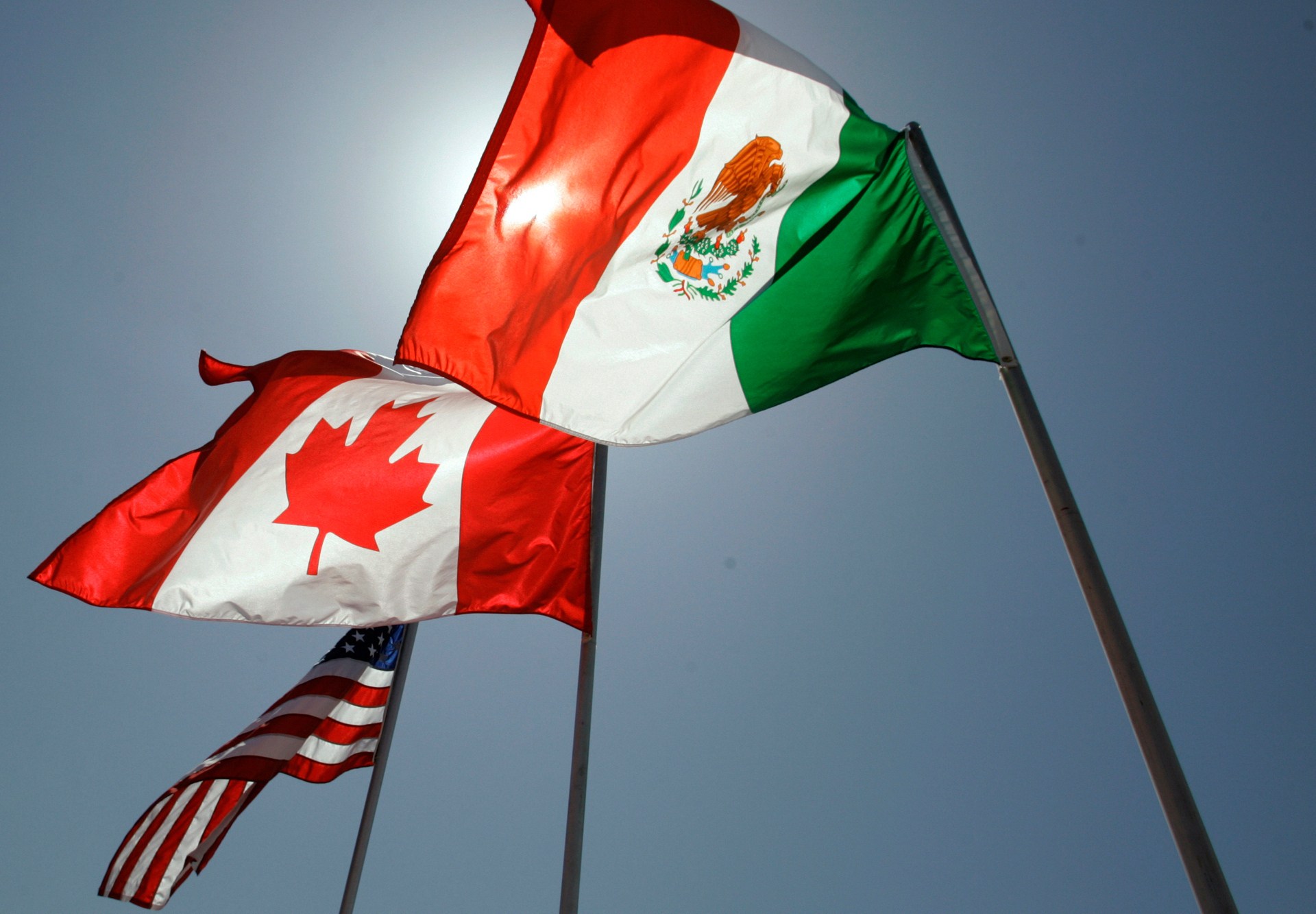

The United States has announced that it will not renew a trilateral trade agreement covering $1.6 trillion of trade between the US, Mexico and Canada, one day before the agreement was due for its first joint mandatory review.
A statement from the US trade representative, Ambassador Jamieson Greer, on Wednesday said the US would not agree to renew the trilateral agreement, also known as USMCA, “in its current form”.
- list 1 of 3Canada sidelined in USMCA renegotiations amid growing trade rifts
- list 2 of 3Mexico and Canada push to extend USMCA trade pact
- list 3 of 3Canada seeks USMCA renewal for 16 years, sector tariff discussions
end of list
“The United States will continue to engage with Mexico and Canada to address the Agreement’s shortcomings and our trade deficits with these countries. However, the Agreement remains in force pending resolution of these issues or until the Agreement’s termination,” the statement read.
It added that the US will meet Mexico during the week of July 20 for a third round of bilateral negotiations related to the USMCA joint review.
The US’s decision not to renew the deal comes after US President Donald Trump repeatedly expressed that he did not see the need for the trade agreement.
In January, Trump said that there was “no real advantage to it; it’s irrelevant,” adding last month, “I don’t know that I’m going to renew it.”
He also signalled that he was open to negotiations with Mexico and Canada, saying, “We’re talking to them. We’ll see if we do something.”
Here’s what we know about USMCA:
What is the USMCA?
The trilateral deal came into effect on July 1, 2020, during Trump’s first term, replacing the North American Free Trade Agreement (NAFTA).
According to the US Department of State, the USMCA, created a “more balanced, reciprocal trade supporting high-paying jobs for Americans and grow the North American economy”.
Advertisement
It also included chapters covering “Digital Trade, Anticorruption, and Good Regulatory Practices, as well as a chapter devoted to ensuring that Small and Medium Sized Enterprises benefit from the Agreement”.
But the US’s latest decision will now trigger a six-year review of the agreement under a “sunset clause” that Trump negotiated in his first term.
Without an agreement to amend the deal, the trade agreement will expire on July 1, 2036.
What is Trump’s criticism of the deal?
Last month, Trump said of the agreement: “We don’t need anything that Canada has. We don’t need anything that Mexico has, but they need everything that we have. And they have to treat us better,” he said.
In advance of the statement, Greer said more time is needed to address problems with the USMCA, which include growing US goods trade deficits with Mexico and Canada, reaching $197bn and $48.3bn respectively in 2025.
For Canada, which is the US’s largest supplier of crude oil, much of the deficit was driven by oil imports, while, for Mexico, the deficit has grown as companies have shifted their supply chains away from China to Mexico in response to Trump’s tariffs on Chinese-origin goods. This means more goods are recorded as being imported to the US from Mexico.
Moreover, a Trump administration official told the news agency Reuters that, despite imposing 25 percent tariffs on both Canada’s and Mexico’s car industries, 50 percent tariffs on metals, and 10 percent tariffs on lumber, the president remains sceptical of any deal with the two countries.
How have Mexico and Canada responded?
Mexican Economy Minister Marcelo Ebrard told a news conference on Wednesday that his country wants to help address US concerns about job losses and trade deficits.
“There is no difference that I can identify between Mexico, the United States and Canada that is so big that we cannot resolve it,” said Ebrard, who joined a virtual meeting with Greer and Dominic LeBlanc, the Canadian minister responsible for US-Canada trade.
“We wouldn’t allow our [car-making] industry to be at a disadvantage,” Ebrard said, adding, “I’d say that has been the main point of discussion with the United States in all these talks: protecting our automotive industry.”
LeBlanc also said Canada would continue to address Trump’s tariffs on his country’s steel, aluminium, cars and lumber.
“We agreed on the importance of continuing our discussions and identifying ways to ensure trade and investment frameworks between Canada, the United States and Mexico continue to support North American prosperity and competitiveness,” he said.
Advertisement
What happens next?
With Canada and Mexico both open to continuing talks to resolve issues related to the USMCA agreement, which will continue until 2036, for the time being, things will be business as usual.
Trump could use tariffs to apply pressure during negotiations.
Alternatively, bilateral agreements could become more important than the trilateral deal; however, they would be unlikely to match the trading strength and volumes under the USMCA.
Related News

Hezbollah rejects Israel-Lebanon agreement as Israeli attacks hit south

Norway seeks to ban trade with illegal Israeli settlements in Palestine

Israel kills ‘a child a day’ on average in Gaza despite ceasefire, UN says