


Syria and Lebanon have long had a complicated relationship, with forces from each country intervening in the other over the years.
United States President Donald Trump has made clear that he would like yet another intervention – making repeated comments in recent weeks calling for Syria to take the lead in disarming the pro-Iranian Lebanese group Hezbollah.
- list 1 of 3US-Iran talks in Doha: What were the outcomes and what’s next?
- list 2 of 3First Syrian parliament since al-Assad’s ousting begins legislative duties
- list 3 of 3At least six killed in explosion inside central Damascus cafe
end of list
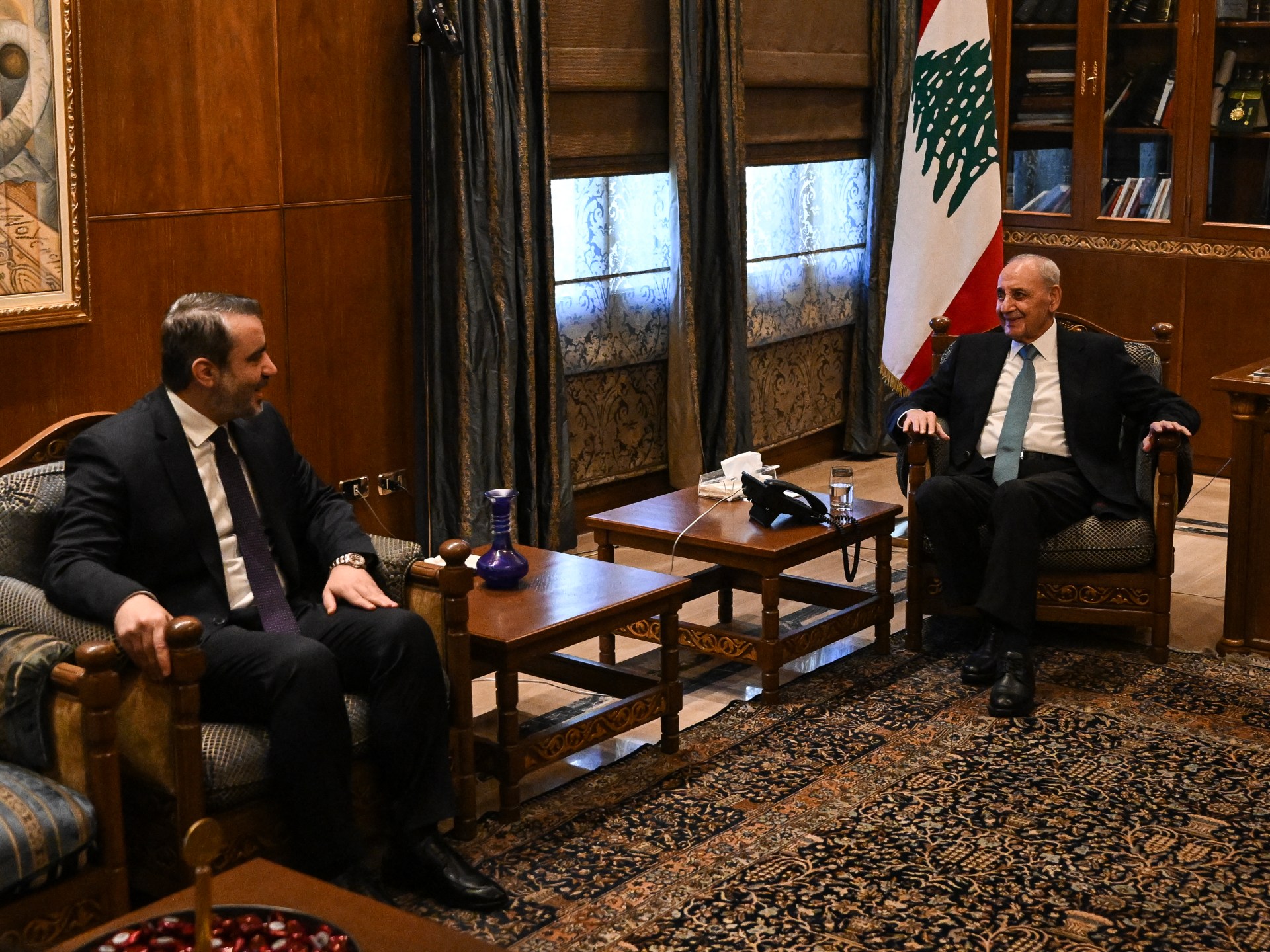
The Syrians have baulked at that idea, and the decision by Syria’s Foreign Minister Asaad al-Shaibani to include Lebanon’s parliament speaker, and key Hezbollah ally, Nabih Berri, among the officials he met during his trip to Beirut on Thursday, is another indication of Damascus’s position.
Even with the Syrian government’s dislike for Hezbollah due to the latter’s military support for the former Syrian regime, it is clear that al-Shaibani’s boss, Syrian President Ahmed al-Sharaa, has no appetite for a military adventure across the border.
“A meeting with Berri signals a reversal from al-Shaibani’s visit last October, when he stayed away from the Shia leadership,” Nawar Hawach, the International Crisis Group’s senior Syria analyst, told Al Jazeera. “It shows that Damascus wants a working line to every Lebanese component, including the bloc closest to Hezbollah.”
Troubled history
If Trump had his way, Syria would be embarking on yet another chapter of its troubled relationship with its smaller neighbour, Lebanon. For decades, the relationship has been one where Syria either dominated or was greatly influential in Lebanon, while Hezbollah has also played its own military role in Syria in the past.
Advertisement
Lebanon and Syria’s complicated relationship dates back to their foundation as nation-states. Some areas of modern-day Lebanon were administered together with parts of Syria during the Ottoman Empire period for centuries, until 1918. Both were then controlled by France, before gaining independence in 1946 – although people inside Lebanon disagreed over whether the country should be its own state or be part of a “Greater Syria”.
Syria – under first President Hafez al-Assad and then his son President Bashar al-Assad – did occupy Lebanon from 1976 until 2005, when Syrian troops pulled out of the country after mass anti-Syrian protests. But al-Assad continued to exert influence over Beirut through local political partners.
That all changed in December 2024, when – after 13 years of war – Syrian opposition groups launched an operation to take government-controlled areas, including Damascus, from the grip of the al-Assad regime. With the latter finally out of power after decades, and his ally Hezbollah no longer welcome in Syria, it was a chance to reset the relationship between Damascus and Beirut.
“Lebanese-Syrian relations can currently be defined as being in a delicate transitional phase, neither a return to the old tutelage model nor a complete break as in the post-2011 period,” Souhayb Jawhar, a Lebanese analyst with Badil, told Al Jazeera. “The new Damascus is attempting to rebuild its relationship with Lebanon under the banner of assistance and integration, not interference or the imposition of influence.”
Hezbollah issue
Part of the sensitivity between the Syrian government and Beirut is down to the role of Hezbollah. The group was long an ally to the al-Assad regime, both being part of the pro-Iran regional “axis of resistance”. When the time came to defend al-Assad in the early years of the war in Syria, Hezbollah responded to the call, and has been accused of carrying out attacks against Syrian civilians.
The current Syrian authorities, therefore, have a history of fighting Hezbollah during the war, and many Syrians detest the group.
Last year, the Syrian government blamed cross-border clashes with Lebanon on Hezbollah, though the group denied involvement.
“Lebanese-Syrian relations look like a cautious reset toward normal state-to-state dealings, but not yet a stable partnership,” Hawach said. “Practical cooperation is advancing, while lingering mistrust and Lebanon’s internal divide over Hezbollah continue to impose a low ceiling on the relationship.”
Advertisement
Hezbollah was weakened in 2024, when Israel killed most of its military leadership, including its longtime Secretary-General Hassan Nasrallah, as it stepped up its attacks in Lebanon. But the group has shown that in the last few months of fighting with Israel that has not been completely demolished as a military force.
Still, Hezbollah’s future remains a big question in Lebanon and in the region. Despite the Lebanese government’s declarations that it will disarm Hezbollah, analysts are uncertain how that will be implemented as long as Israel occupies large swaths of Lebanese territory, and so long as Iran continues to insist on linking the Lebanese arena to any agreement with the US and Israel.
Al-Shaibani met both Lebanese President Joseph Aoun and Prime Minister Nawaf Salam during his trip, but it was the meeting with Berri that was perhaps most revealing. It indicates a sort of practical reset, analysts said, acknowledging the Shia role in Lebanon and aiming to offer Syria’s support for internal dialogue and stability.
“The significance of Asaad al-Shibani’s meeting with Nabih Berri lies in the fact that it opens a direct Syrian channel to the Shia community, not just to the official Lebanese state,” Jawhar said. “Damascus believes that engaging with Berri could provide a way to reassure the Shia, open a discussion on internal stability, and ensure that weapons are solely in the hands of the state, without pushing matters toward confrontation.”
That attempt to reassure Lebanon’s Shia is also significant because Syria’s leadership is largely made up of ex-fighters, many of whom fought for conservative Sunni Muslim groups, as well as some – including al-Sharaa – being formerly associated with al-Qaeda.
“Furthermore, Berri possesses the ability to manage compromises,” Jawhar continued, “and he understands that any discussion of Hezbollah’s weapons can only take place through a gradual, internal process, beginning with a cessation of Israeli attacks and withdrawal, followed by a discussion of a national security strategy.”
After al-Shaibani’s meeting at Prime Minister Salam’s office, he delivered a statement rejecting Israel’s attacks on Lebanon and said that the recent Israel-Lebanon framework agreement was an internal issue. Syria and Lebanon have both, like Gaza, faced Israeli aggression and territorial expansion.
The comments and emphasis on Lebanese sovereignty come on the back of suggestions by Trump that Syria could be relied on to disarm Hezbollah, instead of Israel.
“Trump’s talk of Syria ‘handling Hezbollah’ looks more like political pressure than a concrete plan,” Hawach said. “Damascus has reasons to rule out a military role in Lebanon, and the visit will likely serve as reassurance.”
Trump’s statements were unpopular in Syria. Al-Sharaa has also denied suggestions that Syria’s military will enter Lebanon to disarm Hezbollah. Even with the group’s unpopularity in Syria, there is an acknowledgement from many that Israel is the bigger problem in the region.
Advertisement
“It seems that Damascus does not want to pursue this course of action,” Jawhar said. “It is true that the new Syria does not want Hezbollah’s weapons to remain a threat to its security or a tool for intervention within Syrian territory; however, it refuses to become a tool in an American or Israeli project to ignite internal Lebanese conflict.”
Analysts warned that such an intervention could lead to a wider regional conflict, which might take on a heavily sectarian dimension.
“Damascus wants to prevent the internationalisation or regionalisation of the Lebanese and Syrian arenas and prefers to address outstanding issues within an Arab framework and through direct dialogue between the two countries,” Jawhar said.
He added that the visit was also focused on Lebanese and Syrian security, and the Israeli withdrawal from southern Lebanon and southern Syria.
“In this sense, the visit represents a Syrian attempt to redefine its relationship with Lebanon: no tutelage, no rupture, no military intervention, but rather political and security coordination that prevents Israel from exploiting internal divisions.”
Related News
Are UK Prime Minister Keir Starmer’s political days numbered?

Another powerful 4.8 magnitude earthquake hits near Venezuela

Deaths, disruptions across Europe: What you should know about the heatwave