
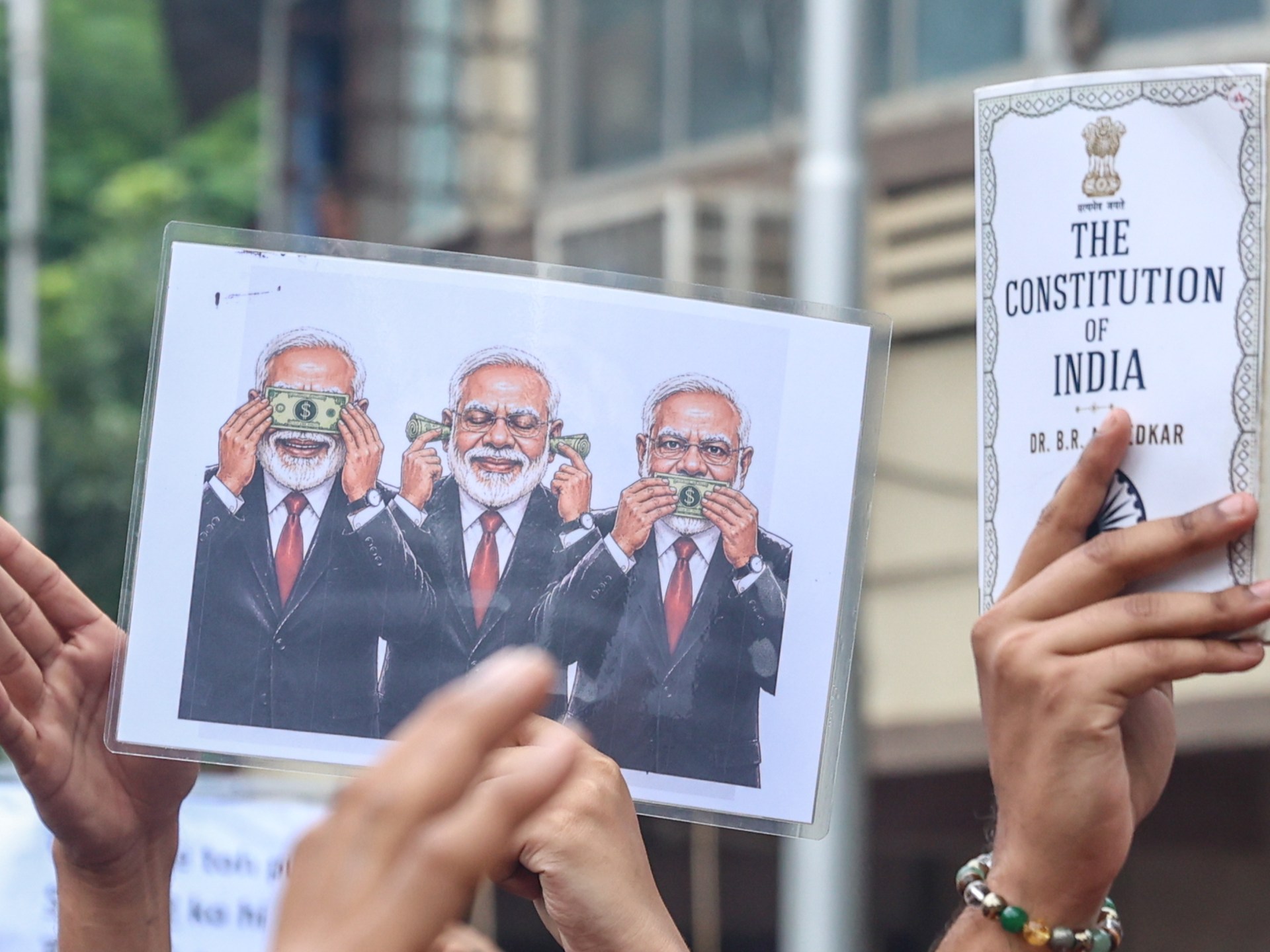

Indian Prime Minister Narendra Modi has pledged to set up fast-track courts to punish those involved in examination paper leaks, offering his first public response to youth-led protests challenging his government.
Demonstrations have grown across New Delhi after reported irregularities in national medical school entrance exams, leading this week to a crackdown by security forces.
- list 1 of 3Water cannon deployed at India education system protests
- list 2 of 3India’s Rahul Gandhi speaks out after release
- list 3 of 3Indian police accused of using pellet guns in crackdown on India’s protests
end of list
Demonstrators have occupied Parliament Street for three days with many camping on the key thoroughfare that connects Parliament House to Connaught Place, the Indian capital’s central commercial square.
“Nothing is more important than the welfare and future of our youth!” Modi wrote on X on Thursday.
“We have decided to set up fast-track courts to ensure swift and stringent punishment for those involved in paper leaks. … Those who try to harm the future of our youth will not be spared.”
The unrest is organised under the Cockroach Janta Party (CJP), a satirical online movement formed in May that has evolved into a national platform demanding structural testing reforms and the resignation of Education Minister Dharmendra Pradhan.
Speaking to the Indian news agency ANI at the Jantar Mantar protest site in New Delhi, the CJP’s founding president, Abhijeet Dipke, accused outside agitators of instigating recent violence to discredit the demonstration.
“People are being sent from outside to deliberately disrupt the protest,” Dipke told ANI. “We have been sitting here for a month. No such incident has happened. … Goons are being sent from outside … to deliberately incite people.”
Advertisement
Dipke later posted on X that Modi appeared “ready to shut down all of Delhi, but not sack Dharmendra Pradhan”.
CJP spokesperson Ashutosh Ranka dismissed Modi’s judicial proposal as insufficient to address underlying systemic failures.
“The announcement of fast-track courts is not a real solution. It is merely a distraction,” Ranka said in a statement at Jantar Mantar. “Paper leaks are not happening because India lacked fast-track courts. They are happening because Education Minister Dharmendra Pradhan has been completely incompetent.”
The CJP’s demands include Pradhan’s immediate resignation, the dropping of cases against peaceful demonstrators and 10 million rupees ($120,000) in financial assistance for each of the families of at least 12 students who have died by suicide since recent exam cancellations.
“On Monday, we saw this group call for a march to Parliament, and we saw unprecedented scenes in the national capital of New Delhi, tens of thousands of people showed up,” Al Jazeera’s Neeha Poonia said, reporting from New Delhi.
“In the last few hours, we’re hearing that 16 metro stations in and around that protest site have been shut by officials,” she added on Thursday. “People there are saying that after what happened on Monday with the police crackdown, that’s only strengthened their resolve not to call off the protest.”
On Monday, demonstrators marching towards parliament were met by police firing tear gas and wielding batons. Smaller demonstrations sprung up on Wednesday in major cities like Mumbai, Bengaluru and Patna.
The rapid rise of the CJP underscores growing dissatisfaction among India’s youth over high unemployment and recurring test leaks. The movement has also provided opposition leaders a key opportunity to challenge Modi and his ruling Bharatiya Janata Party.
Related News
French Parliament approves landmark assisted-dying bill

UN chief fears for ‘millions’ of Palestinians amid UNRWA funding shortfall

Hunger is falling but is still higher than pre-COVID levels: UN report