
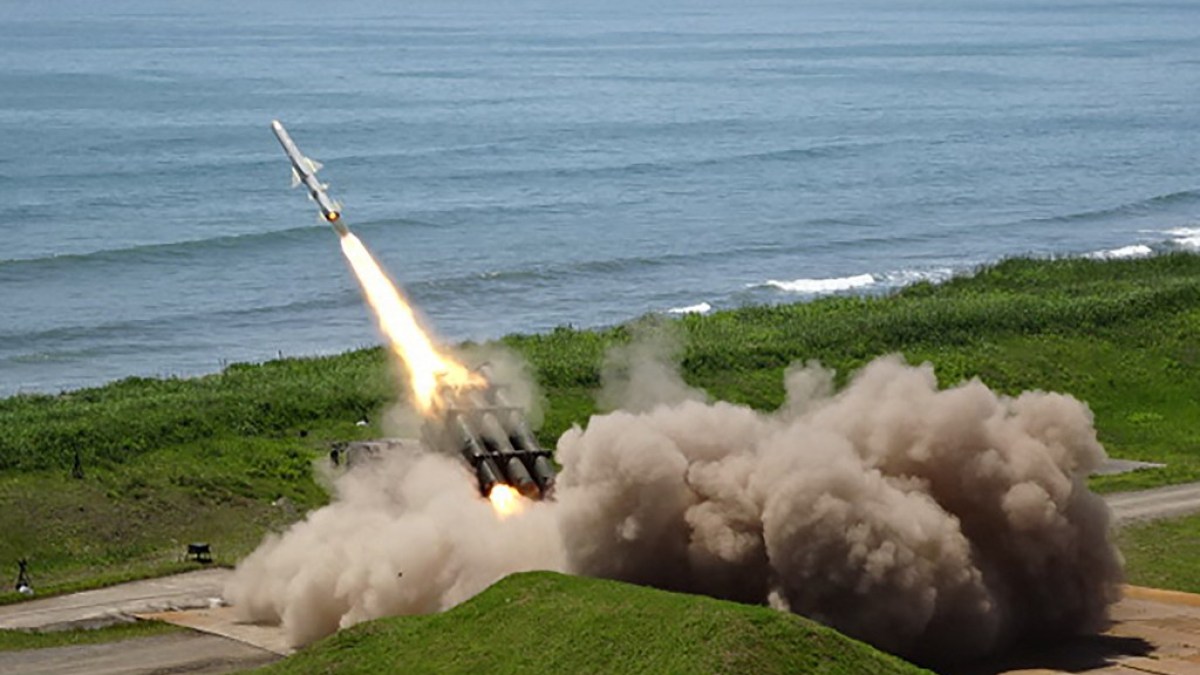

Japan’s plans to deploy missiles on its westernmost island, close to Taiwan, within five years will further add to the growing tensions with China, analysts say.
Japanese defence minister Shinjiro Koizumi said the surface-to-air systems – designed to intercept aircraft and ballistic missiles – will be deployed to Yonaguni island, located about 110km (68 miles) east of Taiwan, which is claimed by China as its sovereign territory, by March 2031.
- list 1 of 3Has BRICS given up on challenging Western economic dominance?
- list 2 of 3Hong Kong conglomerate says Panama Canal ports seized by authorities
- list 3 of 3Tokyo protests as China blocks ‘dual-use’ exports to 20 Japanese companies
end of list
“It depends on the progress of preparing facilities, but we are planning for fiscal 2030,” Koizumi told reporters on Tuesday, providing the clearest timetable so far.
Analysts say the move signals a deliberate hardening of Japan’s posture.
Japan’s decision represents a “calculated escalation that will increase regional tensions,” said Einar Tangen, senior fellow on geopolitics at the Centre for International Governance Innovation (CIGI).
“These actions are not occurring in a vacuum,” Tangen told Al Jazeera. “[The] actions are timed to strengthen Prime Minister Sanae Takaichi’s hand ahead of a visit to Washington, scheduled for March 19, 2026.”
Why Yonaguni matters
Yonaguni sits at the southwestern edge of Japan’s territory, close enough to Taiwan to see its coastline on a clear day.
The island forms part of the Ryukyu chain, a string of more than 55 islands stretching towards Japan’s main islands. Over recent years, Tokyo has expanded military infrastructure across the archipelago, installing radar systems, ammunition depots and missile batteries.
Advertisement
While Japan first announced plans in 2022 to enhance Yonaguni’s defences, this marks the first time officials have committed to a specific deployment deadline.
Where does Taiwan fit into this?
Relations between Tokyo and Beijing have remained strained since Takaichi publicly raised the possibility of military involvement in a Taiwan contingency during parliamentary remarks last November.
Her comments marked a noticeable departure from Japan’s longstanding ambiguity over Taiwan. They also came shortly after the 80th anniversary of the end of Japan’s colonial rule over Taiwan, adding historical sensitivity for Beijing.
Beijing, which considers Taiwan part of its territory, condemned the remarks as provocative.
“Japan must fully repent for its war crimes, immediately stop its wrong and provocative statements and moves that interfere in China’s internal affairs, and stop playing with fire on the Taiwan question,” China’s Foreign Ministry said in response.
China subsequently discouraged travel to Japan. Chinese visitors contribute roughly $11bn annually to Japan’s economy.
Beijing has also increased military and economic pressure, dispatching naval vessels near Japanese waters, tightening controls on rare earth exports and scaling back cultural exchanges, including withdrawing giant pandas from Tokyo’s Ueno Zoo, a symbol for China of friendship between the two sides. China dominates the production of rare earths used in the manufacturing of electric cars, phones and other high-tech devices.

What’s different now?
Some analysts view the missile deployment as part of a longer trajectory.
“This is the continuation of a process under way since at least [late Japanese Prime Minister] Shinzo Abe’s 2014 reinterpretation of collective self-defence,” said Arnaud Bertrand, a geopolitical analyst specialising in China.
Abe’s government controversially reinterpreted Japan’s pacifist constitution to allow limited collective self-defence, expanding the role of the Self-Defense Forces.
“Each step was presented as modest and defensive: coastal surveillance on Yonaguni in 2016, missiles on Ishigaki in 2023, electronic warfare units, and now this,” Bertrand said.
However, he argued that Takaichi has gone further by explicitly linking Japan’s military preparations to a possible Taiwan conflict.
“That’s what makes this moment significant: the political declaration that Japan sees itself as a party to any potential Taiwan conflict, which from China’s standpoint – and in terms of international law – is very provocative, given that Taiwan is China’s sovereign territory that used to be colonised by Japan.”
Advertisement
Japan’s defence priorities have also shifted. Whereas Tokyo once focused heavily on threats from Russia in the north, it now concentrates on countering Chinese military activity in the East China Sea.
Why is Japan doing this now?
Beijing has not yet formally responded to Koizumi’s latest statement. When the minister visited Yonaguni in November, Chinese officials accused Japan of attempting to “create regional tension and provoke military confrontation”.
Shortly afterwards, Chinese drones approached the area, prompting Japan to scramble fighter jets.
“As for the timing, Japan is making this announcement now because the window for military build-up without major consequences is perceived to be closing – China’s capabilities are growing rapidly, and there’s certainly a sense in Tokyo that if it doesn’t establish these forward positions now, it may not be able to later,” Bertrand said.
The United States has also pushed allies to increase defence spending and assume a greater share of regional security responsibilities, particularly under President Donald Trump’s administration.
Domestically, Takaichi strengthened her position after her party secured a commanding majority in February’s parliamentary elections.
“The missile deployment and tough stance on China will resonate with her right-wing base and reinforce an aggressive defence posture, while moving the country away from its post-war pacifist constitution and principles,” Tangen said.
“From China’s perspective, the sequence of events is clear: Japan, under a newly emboldened Prime Minister Takaichi, is aggressively militarising and interfering in the Taiwan question to curry favour with the United States,” he added.
How is China likely to react?
China has already taken economic steps. It recently restricted exports to 40 Japanese entities that it said contribute to Japan’s “remilitarisation”. The Commerce Ministry placed 20 firms on an export control list and added another 20 to a watchlist.
Japan’s Deputy Chief Cabinet Secretary Sato Kei described the move as “deplorable” and said it would “not be tolerated”.
“If further provocations occur, China will extend sanctions to the civilian side, which could literally stop Japanese automobile production. Possibly one of the reasons for the 2031 deployment date,” Tangen said.
Bertrand stressed the depth of China’s focus on Taiwan.
“Taiwan isn’t just important to China – it is what Chinese officials call the ‘core of core interests’.”
“It’s the one issue on which there is genuine consensus across Chinese society, government and military,” he said.
Economic interdependence also complicates matters.
China has been Japan’s largest trading partner since 2005. Bilateral trade reached $322bn in 2024, and China accounts for roughly one-fifth of Japan’s total exports and imports. Japan runs a substantial trade deficit with China, importing about $43bn more annually than it exports.
“Japan cannot simultaneously militarise against China and maintain the economic relationship that its prosperity depends on. At some point, Tokyo will have to choose, and Beijing is trying to make that choice become as obvious as possible,” Bertrand said.
Related News
Schools shut, troops on streets: Mexico on alert after ‘El Mencho’ killing

Russia-Ukraine war: List of key events, day 1,450
Turkish ‘threat’ talked up in Israel as Netanyahu focuses on new alliances