

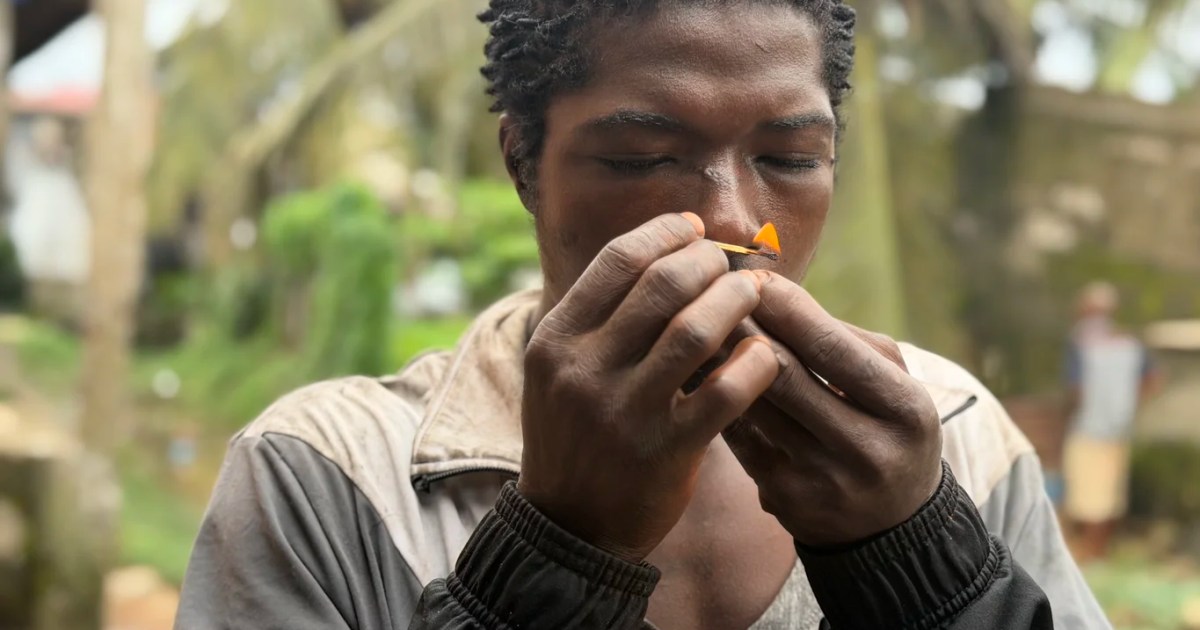

Monrovia, Liberia – On the streets of Liberia’s capital, the signs of the kush crisis are increasingly hard to miss. Young people gather in neighbourhoods where families say addiction has pulled children away from school, their homes and their communities.
Kush, a cheap and highly addictive synthetic street drug, has spread across parts of West Africa and become one of Liberia’s most urgent public concerns.
First reported in neighbouring Sierra Leone, it has since spread into Liberia, where parents say they have watched young people slip into addiction and struggle to return to everyday life.
For Miata Paye, the crisis is not a statistic. It is her son.
Paye told Al Jazeera that her son was in the 10th grade in 2018 when he first encountered kush. Twice, she paid for rehabilitation, $80 and a 25kg (55-pound) bag of rice each time, money and food supplies her family could barely afford.
She hoped each treatment would help him recover, but after both attempts he returned to the roadside.
“This thing is killing our children,” she said. “My heart is bleeding.”
Liberia declared drug abuse a public health emergency in 2024, but for families like Paye’s, the emergency has long been personal.
Young lives disrupted
Paye’s experience reflects what many families across Liberia are facing as kush spreads among young people. Some have left school and ended up living on the streets, where they are often known locally as zogos.
Abraham Jackson is among them. He has smoked kush since he was 16. Now 26, he never completed 10th grade.
Advertisement
Jackson told Al Jazeera that after his mother died, his father disowned him, leaving him without the support he depended on.
![Abraham Jackson, 26, far right, sits with other kush users at a drug den in Monrovia. Users are known locally as zogos. [Lennart Dodoo/Al Jazeera]](https://www.aljazeera.com/wp-content/uploads/2026/07/preview-2-1785512792.webp?w=770&resize=770%2C578&quality=80)
“Since my mother died, my father disowned me,” he said. “Nobody would pay attention to me.”
His story shows how addiction can deepen poverty, family breakdown and homelessness, making recovery far harder.
For families trying to help relatives recover, treatment options remain limited. Liberia’s government rehabilitation centre in Bentol City, about 30km (19 miles) from Monrovia, remains unfinished. Many families are left to seek help from private facilities, some of which doctors say operate without trained staff or proper oversight.
While families grapple with the visible consequences of kush, authorities have uncovered evidence of a much larger narcotics trade operating through Liberia.
Figures obtained by Al Jazeera from the Liberia Drug Enforcement Agency (LDEA) show that between September 2025 and 22 June 2026, the agency arrested 1,167 people on allegations of drug trafficking.
During the same period, Liberian courts recorded only eight convictions, about one conviction for every 146 arrests.
The figures suggest a criminal justice system that arrests suspected traffickers far more often than it secures convictions, raising questions about whether enforcement efforts are reaching those who organise and finance the trade or mainly those caught at the lowest levels.
The scale of the trafficking networks operating through Liberia became clearer through two major cocaine seizures.
On June 8, security officers at Roberts International Airport in Harbel, Margibi County, about 55km (34 miles) southeast of Monrovia, opened six cargo boxes declared as food seasoning and textiles.
Inside were nearly 200 compressed blocks of cocaine weighing 237.6kg (523.8 pounds), with an estimated value of about $19.2m.
Investigators believed the shipment had been prepared for export.
Weeks later, security forces raided a warehouse in Duazon, Margibi County, recovering nearly four tonnes of cocaine. Police Inspector General Gregory Coleman described it as the largest cocaine seizure in Liberia’s history, estimating its value at roughly $317m.
The seizures revealed a broader reality: while communities struggle with kush on the streets, international trafficking networks appear to be using Liberia as a route for much larger shipments.
Advertisement
Traffickers adapt
Authorities say the drug market has continued to evolve as traffickers adjust to enforcement pressure.
According to LDEA figures obtained by Al Jazeera, kush seizures more than doubled, rising from 80.15kg (176.7 pounds) in 2025 to 166.88kg (367.9 pounds) between September 2025 and 22 June 2026.
About 38 percent of those arrested were foreign nationals, mainly from Ivory Coast, Guinea, Nigeria and Sierra Leone, according to the agency.
The market also shifted after Liberia banned tramadol, an opioid painkiller, in August 2025. While seizures of the drug declined, tapentadol seizures rose sharply, increasing from 3.61kg (7.96 pounds) to 198.5kg (437.6 pounds).
Investigators say the changes show how quickly traffickers adapt when authorities increase pressure.
“Traffickers treated the emergency declaration like a weather report,” Special Agent G Orlando Demey of the LDEA told Al Jazeera.
“When the president declared it, they slowed down. After the year passed, they decided to increase.”
The exact contents of kush remain unclear in Liberia. Authorities know the drug is spreading, but further testing is still needed to determine the substances being mixed into it. Research from other parts of West Africa has found that kush can contain dangerous combinations of synthetic substances, making its effects unpredictable.
Communities on the front line
The damage has spread beyond those using the drug. Across Liberia, local leaders have become a bridge between residents and authorities, helping identify drug hotspots and support efforts to respond to the growing problem.
Thomas Wesseh is one of them. He has helped authorities locate drug ghettos in his community, but the crisis has also reached his own home: His son dropped out of college after two semesters and now lives in a cemetery.
![A wrap of kush, a synthetic drug [Lennart Dodoo/Al Jazeera]](https://www.aljazeera.com/wp-content/uploads/2026/07/preview-1785512717.webp?w=768&resize=768%2C1024&quality=80)
Wesseh told Al Jazeera that residents who cooperate with authorities often feel vulnerable because suspected dealers return after police operations end.
“The LDEA would carry out a raid, and after two days, they’re back in the community and begin to threaten us,” he said.
For Wesseh, raids offer only temporary relief. The deeper problem, he said, is that communities are left exposed when suspected dealers return and threaten those who cooperated with authorities.
The government has promised tougher enforcement, asset seizures, border controls and expanded rehabilitation services. But for families like Paye’s, the question is whether the response will move beyond those struggling with addiction and reach those bringing the drugs into the country.
For Paye, the crisis is not only about the drugs entering Liberia. It is about the young people left behind after they arrive.
“They are only after the users, not the ones bringing it in,” she said.
Related News

Trump’s war on Stars and Stripes: Why has military newspaper chief quit?

Body of climber Nirmal Purja, six others recovered after Pakistan avalanche
As Spain grieves, recurrent heatwaves stir fears of more wildfires