

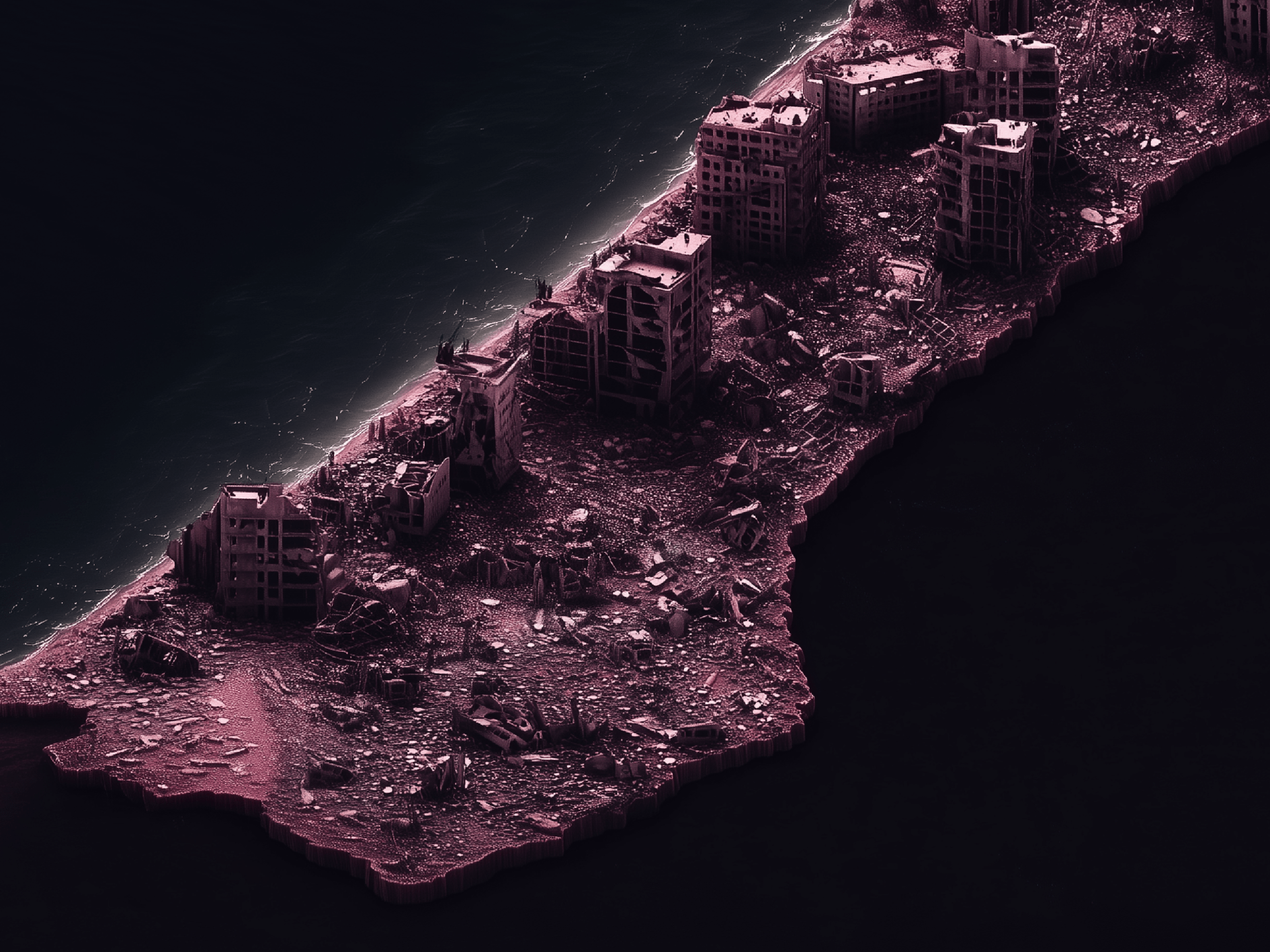

Rebuilding Gaza will cost seven times more than all previous rebuilding efforts in Gaza combined in the last two decades, according to a new joint Oxfam report.
The devastation from more than two years of war has killed at least 73,000 Palestinians, injured 173,000 and displaced 1.9 million. It has left the Gaza Strip needing an estimated $71.4bn to recover, according to the UN-EU-World Bank Rapid Damage and Needs Assessment (RDNA) released in April.
Human development has been set back by 77 years according to the new report by Oxfam, the Palestine Economic Policy Research Institute (MAS) and the Palestine Trade Centre (PalTrade), which asserts that the rebuilding of Gaza cannot move forward without direct Palestinian involvement.
“Reconstruction is not only a humanitarian task; it is a political one. A plan designed in foreign capitals, however well-funded, would be a cosmetic exercise – simply another form of control over Palestinian land and lives. Our consultations across Gaza carried one unmistakable message: nothing about our future without us,” Misyef Jamil, senior researcher at MAS, said.
How much will it cost to rebuild Gaza?
In April, the Gaza Rapid Damage and Needs Assessment (RDNA) estimated it will cost more than $71.4bn over the next 10 years for recovery and reconstruction of the Gaza Strip. That report estimated that Gaza had suffered $57.9bn in total damage and economic losses.

It also found that $26.3bn will be required in the first 18 months of Gaza’s reconstruction to restore essential services, rebuild critical infrastructure and support its economic recovery.

To put $71.4bn into perspective, it’s enough to fund the construction of nearly 48 Burj Khalifas, the world’s tallest building.

This is seven times the combined construction following each Israeli military offensive in Gaza over the past two decades, according to Oxfam, which compared recovery-needs assessments across Gaza’s major wars since 2008.
Advertisement
What is the scale of destruction and human toll?
The report outlines the level of destruction to housing, education and healthcare as well as the impact on the cultural and social fabric that has been erased as a result of the loss of mosques, museums and other cultural landmarks.
According to the report and OCHA:
- 371,888 housing units have been destroyed or damaged
- There are 66 million tonnes of rubble – equivalent to the mass of 11 Pyramids of Giza
- More than 50,000 people need long-term rehabilitation
- 83 percent of people with disabilities were forced to abandon their assistive devices
- More than 58,000 children have lost one or both parents
- 55 percent of hospitals are not functioning
- 93 percent of school buildings have been damaged or destroyed

Before reconstruction can begin, an estimated 66 million tonnes of rubble must be cleared. The debris has left entire neighbourhoods impassable, particularly for people with disabilities, many of whom are effectively confined because they cannot navigate the devastated landscape.
The rubble also poses serious health and safety risks. It is believed to contain unexploded bombs and shells, threatening both clearance crews and nearby communities. Damaged buildings may release asbestos and other hazardous materials into the air, while sewage, medical waste and industrial chemicals further contaminate the environment.
Adding to the challenge, an estimated 8,000 to 11,000 Palestinians are believed to be buried under the rubble. Their remains must be recovered, and they must be identified with dignity before large-scale rebuilding can proceed.
Clearing the rubble is a massive undertaking involving the removal, sorting, decontamination, recycling and disposal of millions of tonnes of debris. It is considered a critical first step towards reconstruction, but one that is expected to take years and require substantial funding, specialised equipment and international support.

How long will it take to rebuild?
The report lays out a five-year plan for rebuilding Gaza which asserts that Palestinians should be in the driving seat throughout the process and not driven by outside plans which risk carving up the Palestinian territories.
Working alongside the European Union, Gulf Arab states, Egypt, the UN and other international agencies, the four-phase roadmap aims to restore Gaza’s essential services, rebuild its infrastructure and lay the foundations for long-term development.
These stages include:
Phase 1: Emergency relief and stabilisation
Advertisement
This phase is centred on access and minimum functioning systems costing about $10bn:
- Secure humanitarian access
- Restore fuel, water, health, shelter and communications
- Clear most pressing rubble and recover human remains
- Provide cash, protection and emergency documentation
- Prioritise women-headed households, disabled people, injured people, older people and caregivers
Phase 2: Early recovery and service restoration
This phase is focused on reconnecting communities, services and local markets and would cost about $15bn:
- Repair damaged housing, clinics, schools, water, sanitation and hygiene (WASH), roads and energy systems
- Restore banking, payments and market access
- Support local firms and Palestinian labour; expand legal aid
Phase 3: Medium-term reconstruction
This is where rebuilding essential infrastructure, institutions and neighbourhood life would come in and cost about $25bn:
- Deliver large-scale housing, schools, hospitals, WASH, energy, transport and municipal systems
- Integrate accessibility, care systems, protection and gender-responsive budgeting
- Rebuild productive assets and public services
Phase 4: Long-term development
The final phase is centred on access and minimum functioning systems costing about $20bn. It would involve:
- Strengthening trade; shifting recovery into Palestinian hands instead of externally
- Helping women in economic participation

Related News
Hamas announces dissolution of Gaza governing body
Hungary elects supreme court judge ousted by Orban as new president

N Korea launches ballistic missile as S Korea, US plan military drills